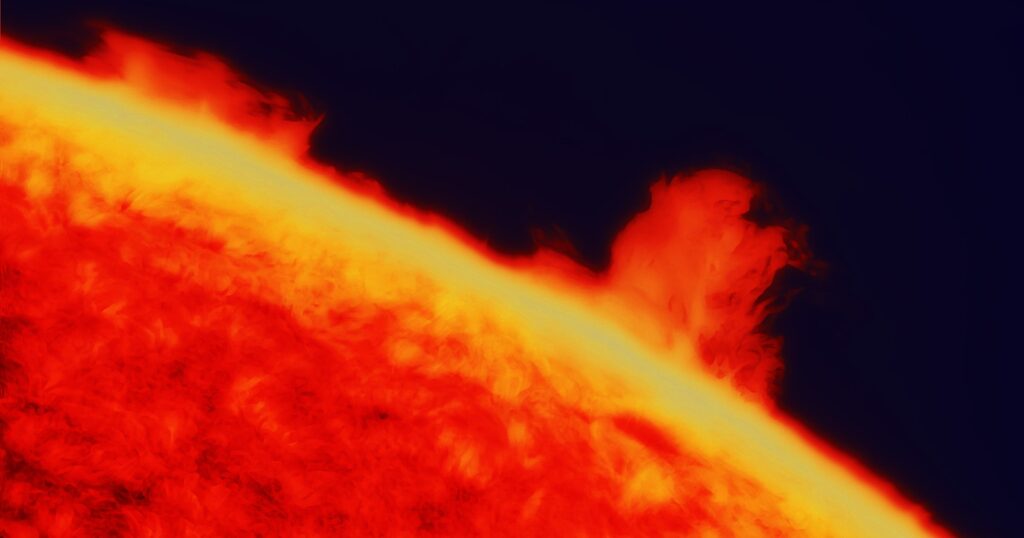

The Sun — usually so predictable — is exhibiting some surprising behavior and that has scientists very intrigued.
Astronomers had predicted that our host star was entering a period of relative quiet back in 2008, but NASA scientists have published a new study in The Astrophysical Journal Letters that found that the Sun has instead defied expectations by becoming more active, with increased sunspots and solar flares.
“All signs were pointing to the Sun going into a prolonged phase of low activity,” said the study lead author and NASA physicist Jamie Jasinski in a statement about the paper. “So it was a surprise to see that trend reversed. The Sun is slowly waking up.”
Back in the 1980s, scientists had noticed the Sun’s surface was steadily quieting down until approximately the 2008 financial crash.
That was the year that the celestial ball of plasma notched its “weakest on record” solar activity — which prompted scientists to predict that this relative state of quietude would keep on extending.
But like a tame camp fire that suddenly crackles into flames and sparks, the Sun abruptly reversed course during the Obama administration with “various plasma and magnetic field parameters” jumping up and the number of sunspots outstripping predictions.
The Sun has long been known to go through periodic cycles of activity every 11 years, called a solar cycle, when it becomes more active — eventually reaching a “solar maximum,” in astronomy parlance — before powering down to a “solar minimum.”
The 11-year period is part of a longer cycle, dubbed the Extended Solar Cycle or Hale cycle, that averages around 22 years, and in which the Sun’s magnetic poles reverse.
But the Sun also goes through longer spans of quiet, such as from 1645 to 1715, and 1790 to 1830, when sunspots basically disappeared. Given the Sun’s long quieting period since the 1980s, scientists had anticipated that was due to happen again — but instead, it seems to be flaring back up.
“We don’t really know why the Sun went through a 40-year minimum starting in 1790,”said Jasinski. “The longer-term trends are a lot less predictable and are something we don’t completely understand yet.”
Why should anybody on Earth care? Increased solar activity impacts our planet by messing up radio communications, power grids, and navigation systems.
And with the United States and China competing in exploring space, monitoring solar activity is important to make sure space travel is safe from any surprising solar conditions that can damage spacecraft and harm astronauts.
Plus, it’s just cool. Ultimately, the Sun is what keeps all life on our planet going, instead of being a frozen husk in space — so its riddles are a matter of existential curiosity.
More on the Sun: Scientists Secretly Working on Plan to Test Blocking Sun From Huge Area of Earth
Source link
Disclaimer
We strive to uphold the highest ethical standards in all of our reporting and coverage. We blogs.grocliq.com want to be transparent with our readers about any potential conflicts of interest that may arise in our work. It’s possible that some of the investors we feature may have connections to other businesses, including competitors or companies we write about. However, we want to assure our readers that this will not have any impact on the integrity or impartiality of our reporting. We are committed to delivering accurate, unbiased news and information to our audience, and we will continue to uphold our ethics and principles in all of our work. Thank you for your trust and support.
Website Upgradation is going on for any glitch kindly connect at [email protected]