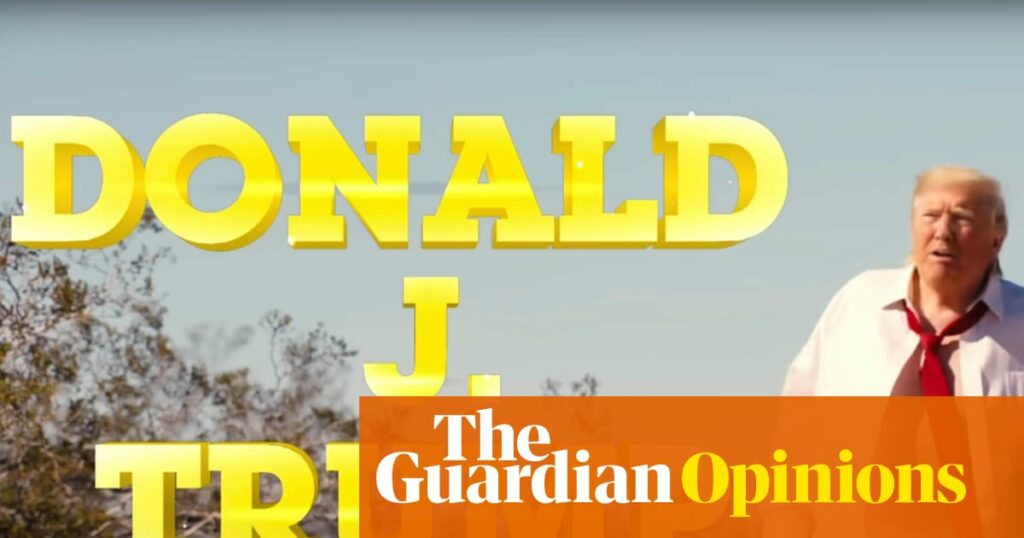

Salman Rushdie believes AI will not be a threat to authors until ChatGPT can write “a funny book”. His faith in human over synthetic creativity may hold some truth in the literary space. But on our screens – from film, art and satire to the algorithmically turbo-charged, factually opaque, monetised churn of the 24/7 news cycle – AI is already making us laugh.
Deepfakes – synthetic audio and video of people doing and saying things they never said or did – are the chief comedic disruptors in a suite of increasingly persuasive AI tools shaping the post-truth reality envisioned by the Microsoft engineer Eric Horvitz, where fact and fiction are indistinguishable. In eight short years, deepfakes have risen from cultural outlier to mainstream meme, embodying the futurist Roy Amara’s Law: we overestimate the effects of new technology in the short run, but underestimate its long-term impacts.
And with some experts predicting 90% of online content could be AI-generated by 2027, the extent to which synthetic replicas will change how we trust and interact with on-screen depictions of real people is now an urgent question for creators, policymakers and viewers.
When deepfakes emerged in 2017 as incel-produced nonconsensual porn, the alarm they generated was justified. But as soon as deepfakes started being used a political tool, concerns snowballed into panic. Philosophers labelled them an “epistemic threat” to evidentiary systems; corporations mounted costly (and unsuccessful) detection programs; and pundits warned of an “info-apocalypse”, in which a convincing deepfake of a world leader could start world war three. Less dramatic but equally chilling was the prediction that the mere awareness of deepfakes would collapse civic trust altogether. In 2018 Jordan Peele made a prophetic deepfake of Obama urging viewers to rely on credible news sources, lest we become a “fucked up dystopia”.
Cut to 2025, and satirical deepfakes are part of the news cycle. Shortly after attending Pope Francis’ funeral, US president Donald Trump posted a viral deepfake of himself in papal regalia. In response to Doge cuts to public services, a deepfake of Trump fellating Elon Musk’s foot appeared on a DC government lobby screen. Following Trump’s declaration he would transform Gaza into a Middle Eastern “Riviera”, a satirical deepfake appeared on Instagram, showing Trump sipping cocktails with Israel prime minister Benjamin Netanyahu in an AI-slop fantasy of Gaza as a beachside resort, full of gold Trump statues and happy Palestinian children. And just last month, South Park’s deepfake of Trump with a micro-penis elicited an official rebuke from the White House.
Deepfakes in fact have been disrupting democratic processes since 2018, when Indian nationalists circulated a deepfake porn video of the journalist Rana Ayyub, in an attempt to silence her. But the elevation of deepfake satire as a weapon in mainstream politics is a more recent trend….
Source link
Disclaimer
We strive to uphold the highest ethical standards in all of our reporting and coverage. We blogs.grocliq.com want to be transparent with our readers about any potential conflicts of interest that may arise in our work. It’s possible that some of the investors we feature may have connections to other businesses, including competitors or companies we write about. However, we want to assure our readers that this will not have any impact on the integrity or impartiality of our reporting. We are committed to delivering accurate, unbiased news and information to our audience, and we will continue to uphold our ethics and principles in all of our work. Thank you for your trust and support.
Website Upgradation is going on for any glitch kindly connect at [email protected]