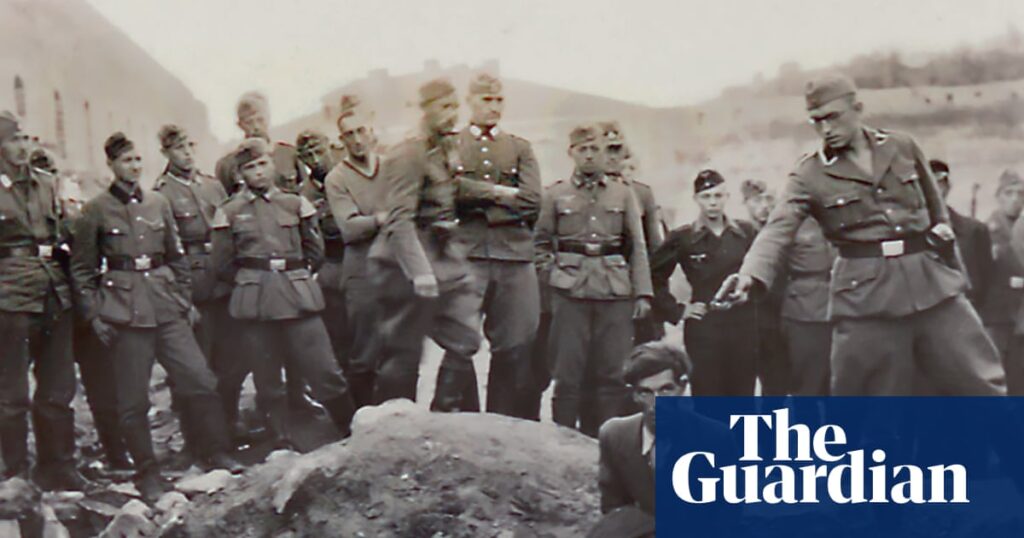

It is one of the most chilling images of the Holocaust: a bespectacled Nazi soldier trains a pistol at the head of a resigned man kneeling in a suit before a pit full of corpses. German troops encircle the scene.
The picture taken in today’s Ukraine was long known, mistakenly, as The Last Jew in Vinnitsa, and was for decades shrouded in mystery.
The US-based German historian Jürgen Matthäus has for years painstakingly assembled the puzzle pieces and, with the help of artificial intelligence, is confident he has identified the killer.
According to findings, he has now published in the respected academic periodical Zeitschrift für Geschichtswissenschaft (Journal of Historical Studies), the SS carried out the massacre on 28 July 1941, most likely in the early afternoon, in the citadel of Berdychiv.
The city was for centuries a thriving centre of Jewish life. It is located 150km south-west of Kyiv and about 90km north of what is now known in English as Vinnytsia, which had long been considered falsely to be the site of the killings.
The Einsatzgruppe C commando, one of several mobile units deployed in the newly occupied Soviet Union, had been engaged in clearing the region of “Jews and partisans” days before a visit by Adolf Hitler.
Among them was Jakobus Onnen, a French, English and gym teacher born in 1906 in the German village of Tichelwarf, near the Dutch border.
Matthäus described an “incremental process” of traditional digging in dusty archives, lucky breaks, input from peers and the trailblazing involvement of volunteers from open-source journalism group Bellingcat.
“The match, from everything I hear from the technical experts, is unusually high in terms of the percentage the algorithm throws out there,” Matthäus said.
Preliminary research published last year allowed Matthäus to reveal the date, location and unit involved in the mass shooting, generating media coverage in Germany.
A reader came forward and said he believed, based on correspondence from the era in his family’s possession, that the gunman could be his wife’s uncle, Jakobus Onnen.
Relatives had destroyed letters from the eastern front from Onnen in the 1990s. But they still had pictures of him, which the Bellingcat volunteers were able to use for an AI image analysis.
“The AI experts tell me that this being a historical photo makes it more difficult to arrive at a 98 or 99.9% [match]” as often yielded in contemporary forensic work, Matthäus said.
But its strong likeness, combined with a mountain of circumstantial evidence, lent him credibility to publish.
“Digital tools in the humanities have massively increased in use, but it’s usually for the processing of mass data, not so much for qualitative analysis,” he…
Source link
Disclaimer
We strive to uphold the highest ethical standards in all of our reporting and coverage. We blogs.grocliq.com want to be transparent with our readers about any potential conflicts of interest that may arise in our work. It’s possible that some of the investors we feature may have connections to other businesses, including competitors or companies we write about. However, we want to assure our readers that this will not have any impact on the integrity or impartiality of our reporting. We are committed to delivering accurate, unbiased news and information to our audience, and we will continue to uphold our ethics and principles in all of our work. Thank you for your trust and support.
Website Upgradation is going on for any glitch kindly connect at [email protected]