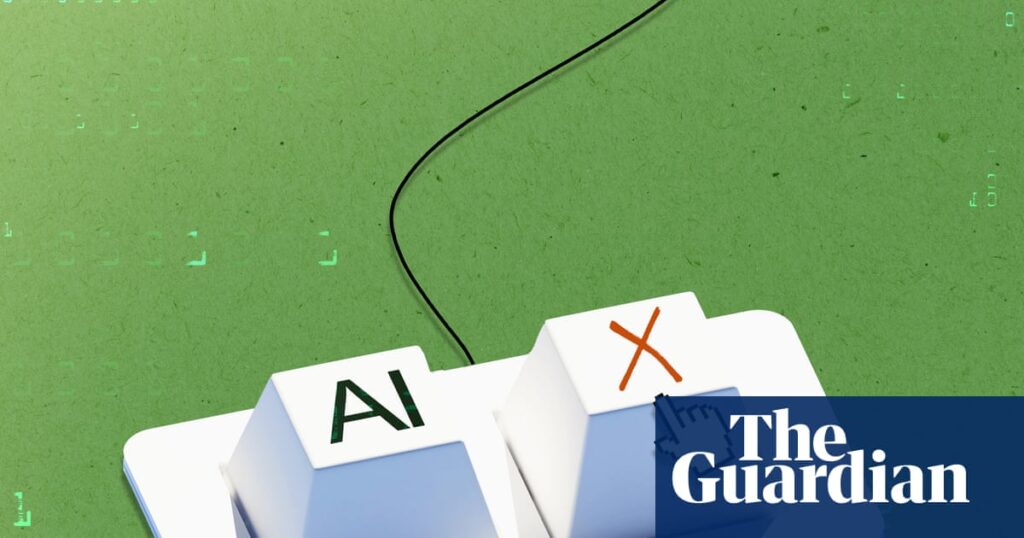

Using a swearword in your Google search can stop that annoying AI overview from popping up. Some apps let you switch off their artificial intelligence.
You can choose not to use ChatGPT, to avoid AI-enabled software, to refuse to talk to a chatbot. You can ignore Donald Trump posting deepfakes, and dodge anything with Tilly the AI actor in it.
As the use of AI spreads, so do concerns about its dangers, and resistance to its ubiquitousness.
Dr Kobi Leins – an AI management and governance expert – chooses to opt out when medical practitioners want to use AI.
She told a specialist she didn’t want AI transcription software used for her child’s appointment but was told it was necessary because the specialist was “time poor” and if she did not want it used she would need to go somewhere else.
“You can’t resist individually. There is also systemic resistance. The push from the industry to use these tools above and beyond where it makes sense [is so strong],” she says.
Where is AI?
AI is spreading inexorably through digital systems.
It’s embedded in applications such as ChatGPT, Google’s AI overview, and Elon Musk’s creation Grok, the super-Nazi chatbot. Smartphones, social media and navigation devices are all using it.
It has also infiltrated customer service, the finance system, online dating apps and is being used to assess resumes and job applications, rental applications – even legal cases.
It’s increasingly part of the healthcare system, easing the administrative burden on doctors and helping to identify illnesses.
A global study from the University of Melbourne released in April found half of Australians use AI on a regular or semi-regular basis, but only 36% trust it.
Prof Paul Salmon, the deputy director of the University of the Sunshine Coast’s Centre for Human Factors and Sociotechnical Systems, says it’s getting harder and harder to avoid.
“In work contexts, there is often pressure to engage with it,” he says.
“You either feel like you’re being left behind – or you’re told you’re being left behind.”
Should I avoid using AI?
Privacy leakage, discrimination, false or misleading information, malicious use in scams and fraud, loss of human agency, lack of transparency and more are just some of the 1,600 risks in the Massachusetts Institute of Technology’s AI Risk Database.
It warns of the risk of AI “pursuing its own goals in conflict with human goals or values” and “possessing dangerous capabilities”.
Greg Sadler, the chief executive officer of the Good Ancestors charity and coordinator of Australians for AI Safety, says he often refers to that database and, while AI can be useful, “you definitely don’t want to use AI in the times where you don’t trust its output, or you’re worried about it having the information”.
Aside from all those risks, AI has an energy cost. Google’s emissions are up by more than 51% thanks at least in part to the electricity consumption of datacentres that underpin…
Source link
Disclaimer
We strive to uphold the highest ethical standards in all of our reporting and coverage. We blogs.grocliq.com want to be transparent with our readers about any potential conflicts of interest that may arise in our work. It’s possible that some of the investors we feature may have connections to other businesses, including competitors or companies we write about. However, we want to assure our readers that this will not have any impact on the integrity or impartiality of our reporting. We are committed to delivering accurate, unbiased news and information to our audience, and we will continue to uphold our ethics and principles in all of our work. Thank you for your trust and support.
Website Upgradation is going on for any glitch kindly connect at [email protected]