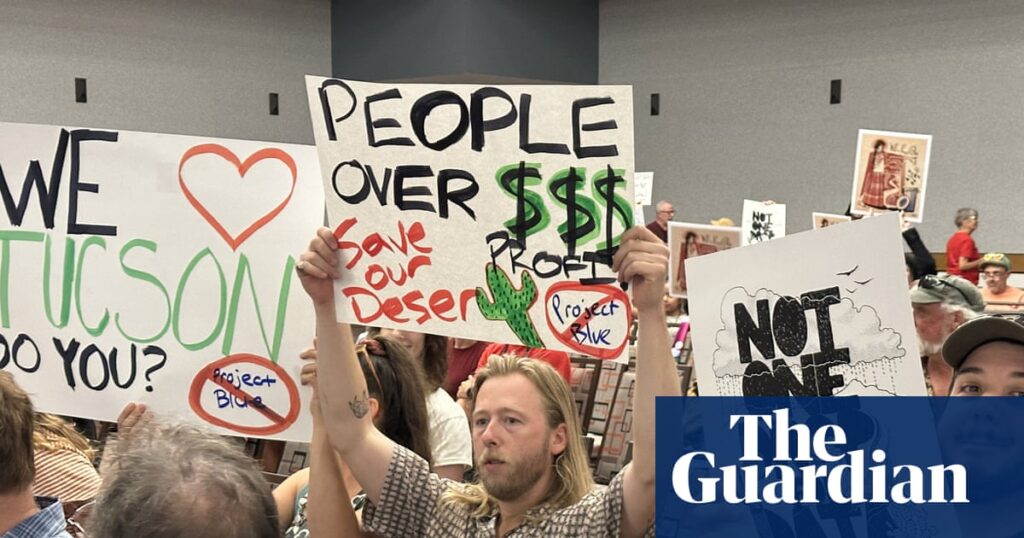

A company’s opaque plan to build a massive data center outside Tucson, Arizona has roiled the desert city over the past few months, the latest US community to push back as tech companies aggressively seek to build out infrastructure for cloud computing and to power the AI boom.
The proposed data center, known as Project Blue, would span 290 acres in Pima county, and become the biggest development ever in the county, or anywhere in the southern part of the state.
The $3.6bn project wasn’t on most Tucsonans’ radar until 17 June, when the county board of supervisors narrowly agreed to sell and rezone a parcel of land just south-east of town to the developer Beale Infrastructure.
The San Francisco-based company hoped to get the project annexed by the city, a necessary step for it to be supplied by the public utility, Tucson Water.
But since the parcel sale agreement, the proposed center has faced stiff pushback from a community upset over the enormous amounts of water and electricity it would require, and the lack of transparency with which the developers and some in local government have pursued the project.
Conflict over the project made what is normally a sleepy time for Tucson politics – the city council is off in July amid searing heat and, with luck, monsoon downpours – into “the craziest seven weeks I’ve seen in Tucson”, said Michael Bogan, an aquatic ecologist and hydrologist at the University of Arizona who has long worked in the area.
The episode in Tucson illustrates the secretiveness and tenacity with which developers are rushing to build data centers throughout the US, and the emotionally charged mix of issues that confront communities, weighing sometimes murky promises of economic incentives and jobs against effects on the environment and natural resources.
In Memphis, Elon Musk’s xAI built one of the world’s biggest supercomputers, bringing in tax revenue to an economically depressed area, while also setting off a battle over air quality concerns related to the development’s methane turbines. Phoenix has one of the nation’s largest concentrations of data centers, which keeps expanding, encouraged by tax incentives and local business leaders; local opposition and ordinances around noise pollution and water use are also on the rise. High-profile projects have been postponed or cancelled due to local pushback in recent months in northern Virginia, the nation’s biggest data center hub; in St Charles, Missouri; and in several towns in Indiana.
But in even more locations, data centers are moving forward, often under a cloud of secrecy.
Quest for AI computing power
The project in Tucson is one of many emerging in the quest for AI computing power and to serve data-intensive companies.
The project envisions a massive warehouse full of computers in the Sonoran desert, including $2.4bn worth of equipment. Community outrage over the project grew soon after…
Source link
Disclaimer
We strive to uphold the highest ethical standards in all of our reporting and coverage. We blogs.grocliq.com want to be transparent with our readers about any potential conflicts of interest that may arise in our work. It’s possible that some of the investors we feature may have connections to other businesses, including competitors or companies we write about. However, we want to assure our readers that this will not have any impact on the integrity or impartiality of our reporting. We are committed to delivering accurate, unbiased news and information to our audience, and we will continue to uphold our ethics and principles in all of our work. Thank you for your trust and support.
Website Upgradation is going on for any glitch kindly connect at [email protected]