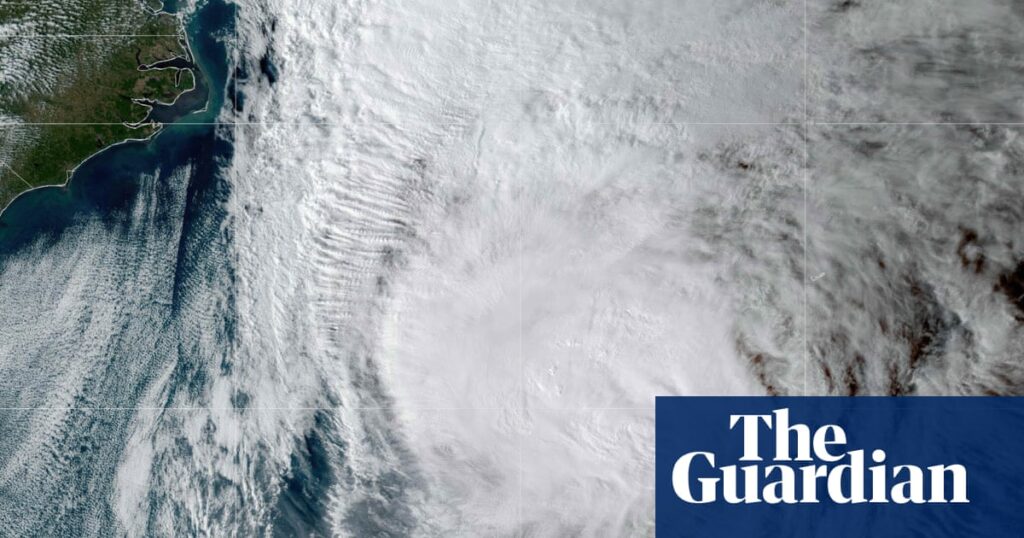

When then Tropical Storm Melissa was churning south of Haiti, Philippe Papin, a National Hurricane Center (NHC) meteorologist, had confidence it was about to grow into a monster hurricane.
As the lead forecaster on duty, he predicted that in just 24 hours the storm would become a category 4 hurricane and begin a turn towards the coast of Jamaica. No NHC forecaster had ever issued such a bold forecast for rapid strengthening.
But Papin had an ace up his sleeve: artificial intelligence in the form of Google’s new DeepMind hurricane model – released for the first time in June. And, as predicted, Melissa did become a storm of astonishing strength that tore through Jamaica.
Forecasters at the NHC are increasingly leaning hard on Google DeepMind. On the morning of 25 October, Papin explained in his public discussion and on social media that Google’s model was a primary reason he was so confident: “Roughly 40/50 Google DeepMind ensemble members show Melissa becoming a Category 5. While I am not ready to forecast that intensity yet given the track uncertainty, that remains a possibility.
“It appears likely that a period of rapid intensification will occur as the storm moves slowly over very warm ocean waters which is the highest oceanic heat content in the entire Atlantic basin.”
Google DeepMind is the first AI model dedicated to hurricanes, and now the first to beat traditional weather forecasters at their own game. Through all 13 Atlantic storms so far this year, Google’s model is the best – even beating human forecasters on track predictions.
Melissa eventually made landfall in Jamaica at category 5 strength, one of the strongest landfalls ever documented in nearly two centuries of record-keeping across the Atlantic basin. Papin’s bold forecast likely gave people in Jamaica extra time to prepare for the disaster, possibly saving lives and property.
Google DeepMind has been making weather forecasts for a few years now, and the parent forecast system from which the new hurricane model is derived also performed spectacularly well in diagnosing large-scale weather patterns last year.
Google’s model works by spotting patterns that traditional time-intensive physics-based weather models may miss.
“They do it much more quickly than their physics-based cousins, and the computing power is less expensive and time consuming,” Michael Lowry, a former NHC forecaster, said.
“What this hurricane season has proven in short order is that the newcomer AI weather models are competitive with and, in some cases, more accurate than the slower physics-based weather models we’ve traditionally leaned on,” Lowry said.
To be sure, Google DeepMind is an example of machine learning – a technique that has been used in data-heavy sciences like meteorology for years – and is not generative AI like ChatGPT.
Machine learning takes mounds of data and pulls out patterns from them in a such a way that its model only takes a few minutes to come up with an answer,…
Source link
Disclaimer
We strive to uphold the highest ethical standards in all of our reporting and coverage. We blogs.grocliq.com want to be transparent with our readers about any potential conflicts of interest that may arise in our work. It’s possible that some of the investors we feature may have connections to other businesses, including competitors or companies we write about. However, we want to assure our readers that this will not have any impact on the integrity or impartiality of our reporting. We are committed to delivering accurate, unbiased news and information to our audience, and we will continue to uphold our ethics and principles in all of our work. Thank you for your trust and support.
Website Upgradation is going on for any glitch kindly connect at [email protected]