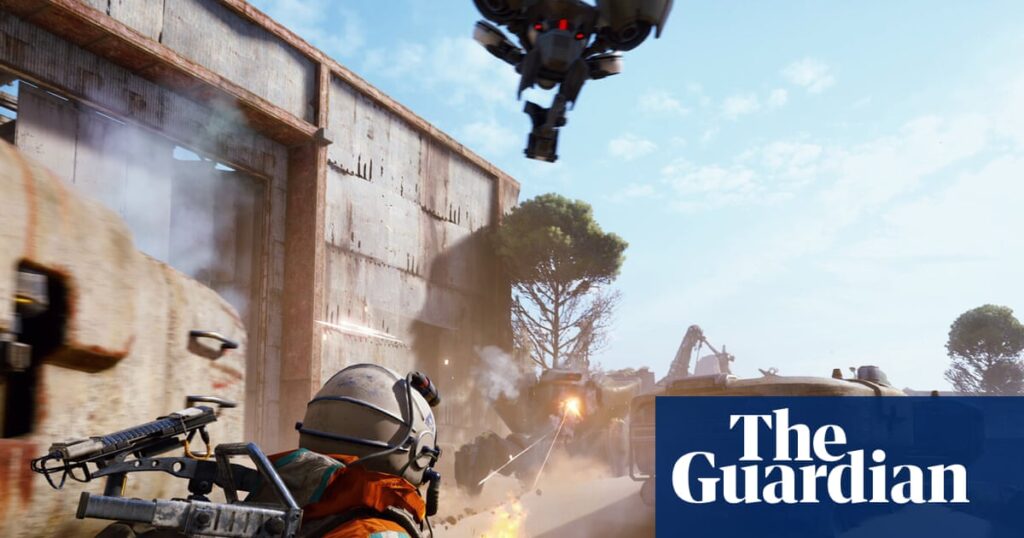

Arc Raiders is, by all accounts, a late game-of-the-year contender. Dropped into a multiplayer world overrun with hostile drones and military robots, every human player is at the mercy of the machines – and each other. Can you trust the other raider you’ve spotted on your way back to humanity’s safe haven underground, or will they shoot you and take everything you’ve just scavenged? Perhaps surprisingly, humanity is (mostly) choosing to band together, according to most people I’ve talked to about this game.
In a review for Gamespot, Mark Delaney paints a beguiling picture of Arc Raiders’s potential for generating war stories, and highlights its surprisingly hopeful tone as the thing that elevates it above similar multiplayer extraction shooters: “We can all kill each other in Arc Raiders. The fact that most of us are choosing instead to lend a helping hand, if not a sign that humanity will be all right in the real world, at the very least makes for one of the best multiplayer games I’ve ever played.”
But, but, but, but … There is a small irony to Arc’s depiction of humanity united against the machines. The game uses AI-generated text-to-speech voices, trained on real actors. (The game also uses machine learning to improve the behaviour and animation of its robot enemies, a different type of “AI”, which video games have been using for ever.) Games writer Rick Lane found this to be so ethically compromising that he couldn’t look past it. “For Arc Raiders to ride the wave of human sociability all the way to the bank, while also being so contemptuous of the thing that makes us social animals – carving up human voices and reassembling them like a digital Victor Frankenstein – demonstrates a lack of artistic integrity that I find impossible to ignore,” he wrote for Eurogamer.
Generative AI in video game development is becoming a red-line issue for many players (although it’s impossible to tell how many – neither social media outrage nor Steam forum sentiment are reliable predictors of how most people actually feel). It gives a lot of people, myself included, the ick. Last week, the new Call of Duty also came under fire (sorry) for using supposedly AI-generated art; people absolutely hate it. Proponents of the use of generative AI in games often say that it empowers smaller developers to do more with less, but Call of Duty is a multibillion-dollar franchise. Activision can more than afford to pay artists to draw something. Given Arc Raiders’s success, you could say the same about its AI voice lines.
It is an existential issue for video game workers – artists, writers and voice actors particularly, but also coders – who may be at risk of losing out to this technology. Many believe that gaming’s corporate overlords would be thrilled to replace expensive, inconvenient humans with machines that generate inadequate but functional work. Take EA, which is mandating that its employees use the company’s internal…
Source link
Disclaimer
We strive to uphold the highest ethical standards in all of our reporting and coverage. We blogs.grocliq.com want to be transparent with our readers about any potential conflicts of interest that may arise in our work. It’s possible that some of the investors we feature may have connections to other businesses, including competitors or companies we write about. However, we want to assure our readers that this will not have any impact on the integrity or impartiality of our reporting. We are committed to delivering accurate, unbiased news and information to our audience, and we will continue to uphold our ethics and principles in all of our work. Thank you for your trust and support.
Website Upgradation is going on for any glitch kindly connect at [email protected]