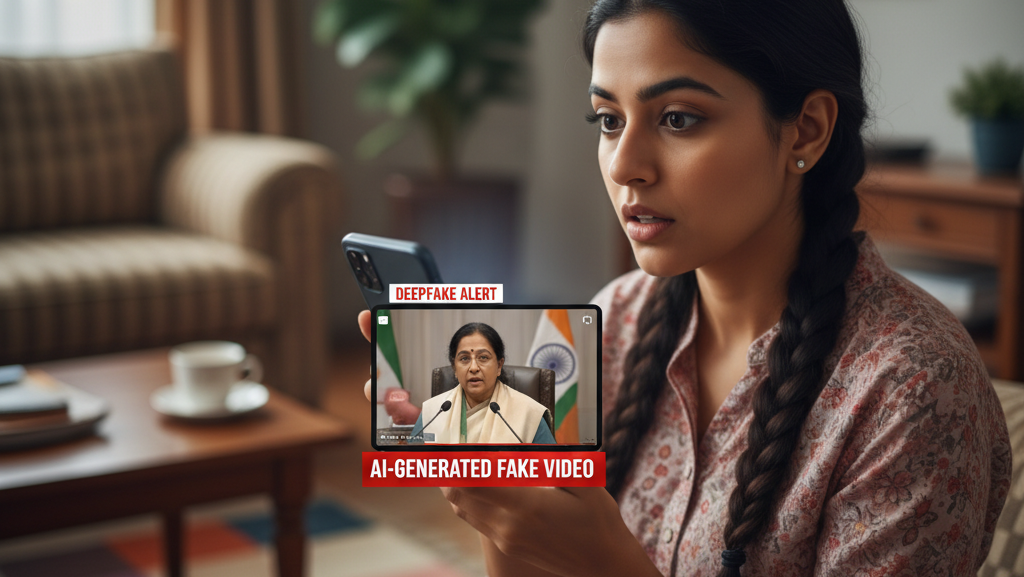

A video of Finance Minister Nirmala Sitharaman promoting a scheme promising massive investment returns went viral on Instagram. The government’s fact-check unit later identified it as a deepfake. This is not an isolated incident of deepfake. From celebrities to ministers, many have fallen victim to malicious deepfakes. A 2024 survey found that over 75% of respondents in India had seen deepfakes, and 38% had been targeted by deepfake scams. While deepfake technology can be used for benign purposes like satire, its use in impersonation, reputational harm, and misinformation has, understandably, drawn criticism. At an individual level, these can cause psychological and reputational harm, and collectively, they blur the line between reality and perception. These are being compounded in India because of its large online population, limited media literacy, fragile media ecosystem, and complex socio-political composition.
On October 22, 2025, the Indian government released draft amendments to the Information Technology (Intermediary Guidelines and Digital Media Ethics Code) Rules, 2021 (“IT Rules, 2021”), requiring primarily Gen-AI and social media platforms to label ‘synthetic information’ towards ensuring an ‘open, safe, trusted, and accountable internet’.
The labelling requirements under the draft amendments would likely operate at three levels: first, at the point of content generation by the Gen-AI tool (which seems to be classified as an intermediary with this amendment, though it may not fit neatly within the IT Act’s definition of intermediary, as it generates rather than hosts content); second, at the user level, requiring disclosure when sharing or posting such content on social media; and third, at the platform level, where significant social media intermediaries like Instagram and YouTube must ensure that content is correctly labelled.
While the intent of the draft amendments is in the right direction, it is crucial to assess the implications of its ambiguous scope and proposed strategy, which could have negative consequences for user rights.
What to Label?
The draft amendments define ‘synthetically generated information’ as “information artificially or algorithmically created, generated, modified, or altered using a computer resource, in a manner that such information reasonably appears to be authentic or true”, which is a broad definition that covers everything from a picture which has been edited to remove a stranger to bad-faith deepfakes of celebrities. This is challenging because users may not view simple AI edits like object removal or colour correction as “synthetic”, while opinions may differ on Gen-AI edits such as facial adjustments, potentially negatively affecting their online experience. The draft amendments are ambiguous on whether users should disclose even minor edits, such as colour adjustments, or only when content is significantly altered or generated using…
Source link
Disclaimer
We strive to uphold the highest ethical standards in all of our reporting and coverage. We blogs.grocliq.com want to be transparent with our readers about any potential conflicts of interest that may arise in our work. It’s possible that some of the investors we feature may have connections to other businesses, including competitors or companies we write about. However, we want to assure our readers that this will not have any impact on the integrity or impartiality of our reporting. We are committed to delivering accurate, unbiased news and information to our audience, and we will continue to uphold our ethics and principles in all of our work. Thank you for your trust and support.
Website Upgradation is going on for any glitch kindly connect at [email protected]