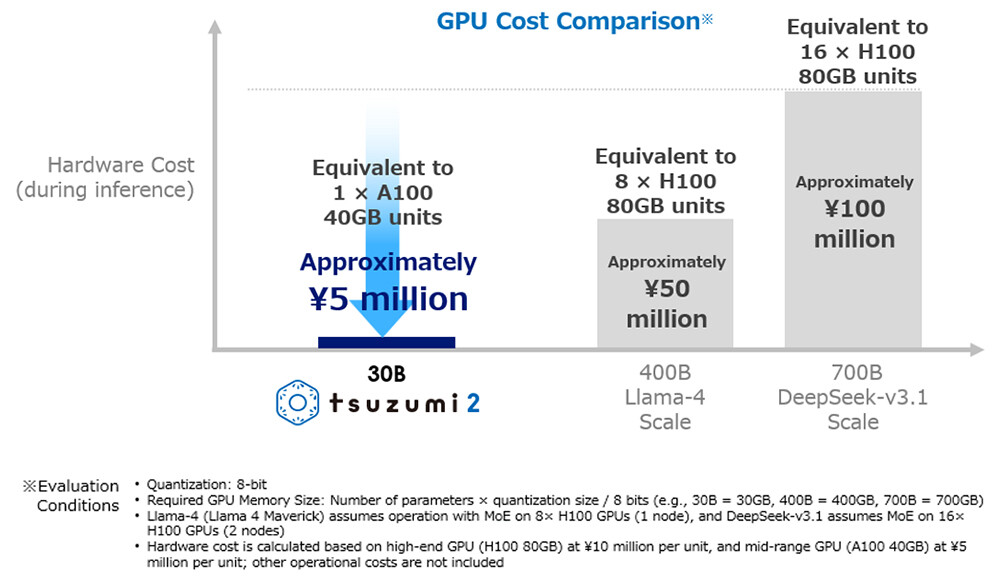

Enterprise AI deployment has been facing a fundamental tension: organisations need sophisticated language models but baulk at the infrastructure costs and energy consumption of frontier systems.
NTT Inc.’s recent launch of tsuzumi 2, a lightweight large language model (LLM) running on a single GPU, demonstrates how businesses are resolving this constraint—with early deployments showing performance matching larger models at a fraction of the operational cost.
The business case is straightforward. Traditional large language models require dozens or hundreds of GPUs, creating electricity consumption and operational cost barriers that make AI deployment impractical for many organisations.

For enterprises operating in markets with constrained power infrastructure or tight operational budgets, these requirements eliminate AI as a viable option. The company’s press release illustrates the practical considerations driving lightweight LLM adoption with Tokyo Online University’s deployment.
The university operates an on-premise platform keeping student and staff data within its campus network—a data sovereignty requirement common across educational institutions and regulated industries.
After validating that tsuzumi 2 handles complex context understanding and long-document processing at production-ready levels, the university deployed it for course Q&A enhancement, teaching material creation support, and personalised student guidance.
The single-GPU operation means the university avoids both capital expenditure for GPU clusters and ongoing electricity costs. More significantly, on-premise deployment addresses data privacy concerns that prevent many educational institutions from using cloud-based AI services that process sensitive student information.
Performance without scale: The technical economics
NTT’s internal evaluation for financial-system inquiry handling showed tsuzumi 2 matching or exceeding leading external models despite dramatically smaller infrastructure requirements. This performance-to-resource ratio determines AI adoption feasibility for enterprises where the total cost of ownership drives decisions.
The model delivers what NTT characterises as “world-top results among models of comparable size” in Japanese language performance, with particular strength in business domains prioritising knowledge, analysis, instruction-following, and safety.
For enterprises operating primarily in Japanese markets, this language optimisation reduces the need to deploy larger multilingual models requiring significantly more computational resources.
Reinforced knowledge in financial, medical, and public sectors—developed based on customer demand—enables domain-specific deployments without extensive fine-tuning.
The model’s RAG (Retrieval-Augmented Generation) and fine-tuning capabilities allow efficient development of specialised applications for enterprises with proprietary…
Source link
Disclaimer
We strive to uphold the highest ethical standards in all of our reporting and coverage. We blogs.grocliq.com want to be transparent with our readers about any potential conflicts of interest that may arise in our work. It’s possible that some of the investors we feature may have connections to other businesses, including competitors or companies we write about. However, we want to assure our readers that this will not have any impact on the integrity or impartiality of our reporting. We are committed to delivering accurate, unbiased news and information to our audience, and we will continue to uphold our ethics and principles in all of our work. Thank you for your trust and support.
Website Upgradation is going on for any glitch kindly connect at [email protected]