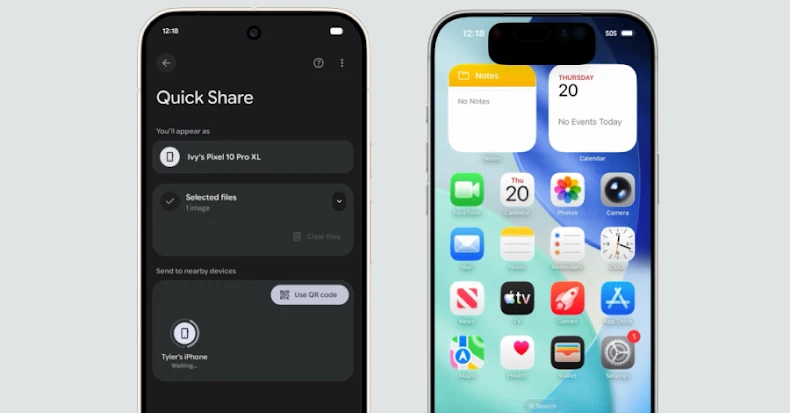


In a surprise move, Google on Thursday announced that it has updated Quick Share, its peer-to-peer file transfer service, to work with Apple’s equipment AirDrop, allowing users to more easily share files and photos between Android and iPhone devices.
The cross-platform sharing feature is currently limited to the Pixel 10 lineup and works with iPhone, iPad, and macOS devices, with plans to expand to additional Android devices in the future.
In order to transfer a file from a Pixel 10 phone over AirDrop, the only caveat is that the owner of the Apple device is required to make sure their iPhone (or iPad or Mac) is discoverable to anyone – which can be enabled for 10 minutes.
Likewise, to receive content from an Apple device, Android device users will need to adjust their Quick Share visibility settings to Everyone for 10 minutes or be in Receive mode on the Quick Share page, according to a support document published by Google.

“We built Quick Share’s interoperability support for AirDrop with the same rigorous security standards that we apply to all Google products,” Dave Kleidermacher, vice president of Platforms Security and Privacy at Google, said.
At the heart of the future is a multi-layered security approach that’s powered by the memory-safe Rust programming language to create a secure sharing channel that Google said eliminates entire classes of memory safety vulnerabilities, making its implementation resilient against attacks that attempt to exploit memory errors.
The tech giant also noted that the feature does not rely on any workaround and that the data is not routed through a server, adding it’s open to working with Apple to enable “Contacts Only” mode in the future.
“Google’s implementation of its version of Quick Share does not introduce vulnerabilities into the broader protocol’s ecosystem,” NetSPI, which carried out an independent assessment in August 2025, said.
“While it shares specific characteristics with implementations made by other manufacturers, this implementation is reasonably more secure. In fact, the process of file exchange is notably stronger, as it doesn’t leak any information, which is a common weakness in other manufacturers’ implementations.”
That said, its analysis uncovered a low-severity information disclosure vulnerability (CVSS score: 2.1) that could permit an attacker with physical access to the device to access information, such as image thumbnails and SHA256 hashes of phone numbers and email addresses. It has since been addressed by Google.

The development comes as Google said it blocked in India more than 115 million attempts to install sideloaded apps that request access to sensitive permissions for financial fraud. The company also said it’s piloting a new feature in the country in collaboration with financial services like Google Pay, Navi, and Paytm to combat scams that trick users into opening the apps when sharing their…
Source link
Disclaimer
We strive to uphold the highest ethical standards in all of our reporting and coverage. We blogs.grocliq.com want to be transparent with our readers about any potential conflicts of interest that may arise in our work. It’s possible that some of the investors we feature may have connections to other businesses, including competitors or companies we write about. However, we want to assure our readers that this will not have any impact on the integrity or impartiality of our reporting. We are committed to delivering accurate, unbiased news and information to our audience, and we will continue to uphold our ethics and principles in all of our work. Thank you for your trust and support.
Website Upgradation is going on for any glitch kindly connect at [email protected]