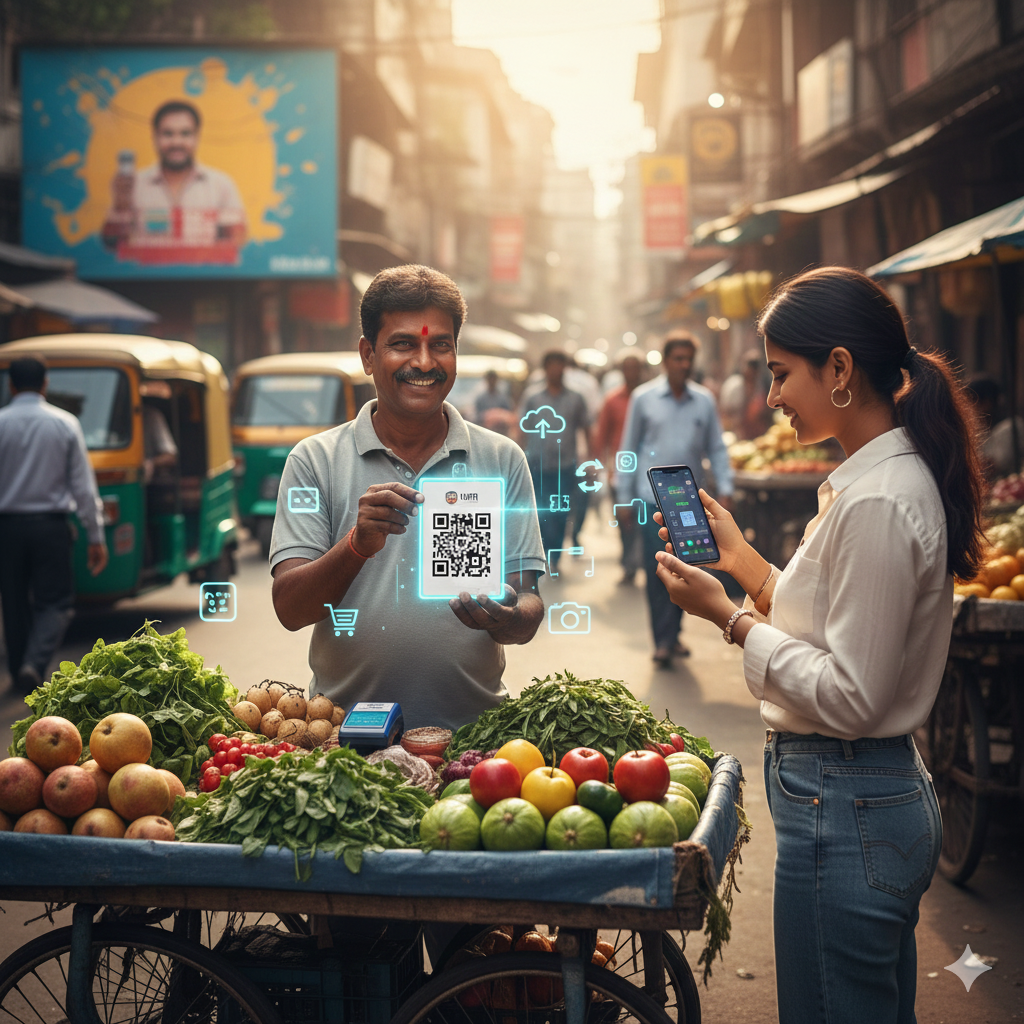

MediaNama’s Take: India is preparing to measure something it has never measured before. National surveys have long treated informal enterprises as offline and cash-driven, with systematic measurement beginning only recently. Earlier enterprise surveys did not capture digital behaviour such as online sales or digital payments, leaving this dimension invisible to policymaking.
However, the Annual Survey of Unincorporated Sector Enterprises (ASUSE) 2026 shifts that approach by tracking whether firms use e-commerce platforms, accept UPI payments, receive online orders, or maintain websites and social-media pages.
For context, the informal sector contributed about 45% of India’s total GDP in FY 2022–23, according to the Ministry of Statistics and Programme Implementation’s (MoSPI) National Accounts Statistics. The Periodic Labour Force Survey (PLFS) 2023–24 also shows that 61% of women workers in the non-agriculture sector are employed in informal enterprises. This scale makes the absence of digital indicators in national surveys even more significant.
Once digital participation enters official measurement, it becomes part of how policymakers understand economic activity. This influences decisions on credit access, taxation thresholds, MSME digitisation schemes and competition policy, all of which depend on reliable data about how enterprises actually operate. Until now, many of those decisions rested on assumptions rather than evidence.
Moreover, the new special codes for Ola and Uber drivers and delivery workers signal another shift. Gig work has grown rapidly, yet it sits outside clean measurement. By introducing platform-linked codes, ASUSE brings gig workers into the statistical framework that future labour and aggregator regulations will rely on.
Ultimately, the impact will depend on execution. Enumerators must record digital use consistently, and MoSPI must publish disaggregated data that captures differences across sectors and states. If managed well, ASUSE 2026 will reveal how deeply informal enterprises use digital tools and correct long-standing blind spots in digital policy design.
What’s the News
The Ministry of Statistics and Programme Implementation (MoSPI) has released the draft schedule for ASUSE 2026 and invited feedback until 20 December 2025. MoSPI will conduct the survey from January to December 2026 across manufacturing, trade, and services in both rural and urban areas.
The draft schedule confirms that MoSPI will measure digital adoption inside informal enterprises for the first time. Enumerators will record whether establishments sell on platforms like Amazon, Flipkart or Meesho, maintain a website or social-media presence, receive online orders, or use UPI and other electronic payment systems.
The schedule also introduces two special activity codes:
- Code 49227 for cab drivers operating under Ola, Uber, Rapido, Meru and similar aggregators.
- Code 96099 for delivery…
Source link
Disclaimer
We strive to uphold the highest ethical standards in all of our reporting and coverage. We blogs.grocliq.com want to be transparent with our readers about any potential conflicts of interest that may arise in our work. It’s possible that some of the investors we feature may have connections to other businesses, including competitors or companies we write about. However, we want to assure our readers that this will not have any impact on the integrity or impartiality of our reporting. We are committed to delivering accurate, unbiased news and information to our audience, and we will continue to uphold our ethics and principles in all of our work. Thank you for your trust and support.
Website Upgradation is going on for any glitch kindly connect at [email protected]