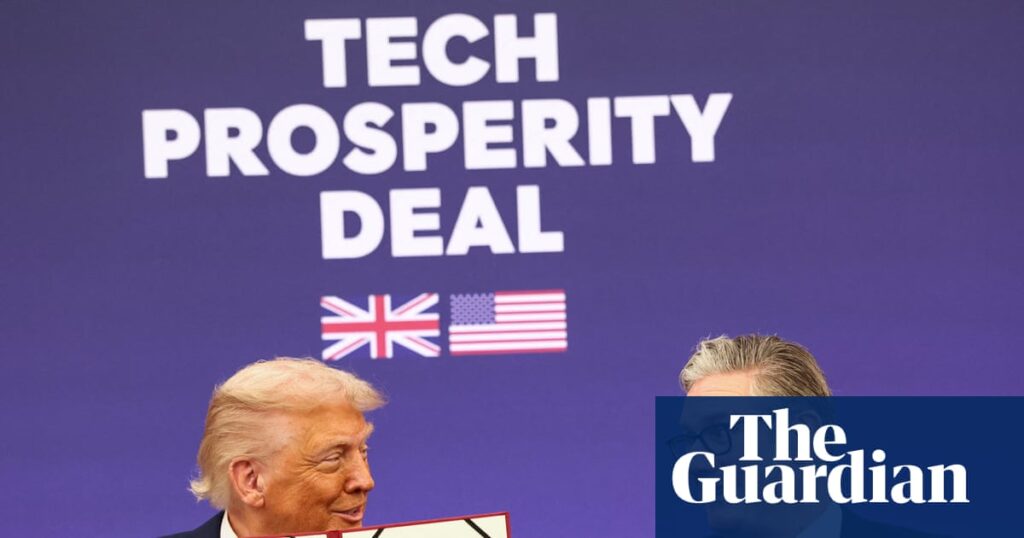

The US has paused its promised multi-billion-pound investment into British tech over trade disagreements, marking a serious setback in US-UK relations.
The £31bn “tech prosperity deal”, hailed by Keir Starmer as “a generational stepchange in our relationship with the US” when it was announced during Donald Trump’s state visit, has been put on ice by Washington.
As part of the deal, US tech companies pledged to spend billions in the UK, including a £22bn investment from Microsoft and £5bn from Google. But Washington has paused the implementation of the agreement, citing a lack of progress from the UK in lowering trade barriers in other areas.
British officials sought to downplay the development, which was first reported by the New York Times. The newspaper said Trump’s administration was unhappy about the UK continuing to levy a digital services tax on American tech companies and its food safety rules, which bar the export of certain agricultural products.
One British government source said it was “the usual bit of hardball negotiations by the Americans” and said that the deal to allow tariff-free British pharmaceutical exports to the US was on and off before it was finalised.
“[The US commerce secretary] Howard Lutnick is a tough guy. We understand that the Americans negotiate incredibly hard but we’ll stand our ground. They want what’s best for their country, we want what’s best for ours,” the source said.
A second government source said the development was “part of the shape of the negotiations” with Washington.
The prosperity deal included the creation of an artificial intelligence “growth zone” in the north-east of England, which UK officials said could bring in up to £30bn and create 5,000 jobs.
But the text of the agreement stated that it only “becomes operative alongside substantive progress being made to formalise and implement” it.
The decision to put it on hold is a blow to the UK government, which touted the agreement as a prize of its intensive year-long engagement with the US to avoid punitive tariffs on British exports. As part of his diplomatic charm offensive, Starmer hosted Trump for a second state visit at Windsor Castle in September, an unprecedented honour for a US president.
Starmer has resisted US pressure to scrap or amend the digital services tax, a 2% levy on the revenues of tech companies including Amazon, Google and Apple that raises about £800m a year. Trump has repeatedly threatened to retaliate against countries with digital taxes, including the UK.
The Guardian revealed that during trade negotiations in the spring, the government drew up proposals to reduce the amount paid by US tech companies and by applying the tax to a wider range of companies without reducing its total take. But so far the tax has remained unchanged.
The US has also exerted pressure over the UK’s online safety rules, with officials promising to review their enforcement during the talks.
A third area of…
Source link
Disclaimer
We strive to uphold the highest ethical standards in all of our reporting and coverage. We blogs.grocliq.com want to be transparent with our readers about any potential conflicts of interest that may arise in our work. It’s possible that some of the investors we feature may have connections to other businesses, including competitors or companies we write about. However, we want to assure our readers that this will not have any impact on the integrity or impartiality of our reporting. We are committed to delivering accurate, unbiased news and information to our audience, and we will continue to uphold our ethics and principles in all of our work. Thank you for your trust and support.
Website Upgradation is going on for any glitch kindly connect at [email protected]