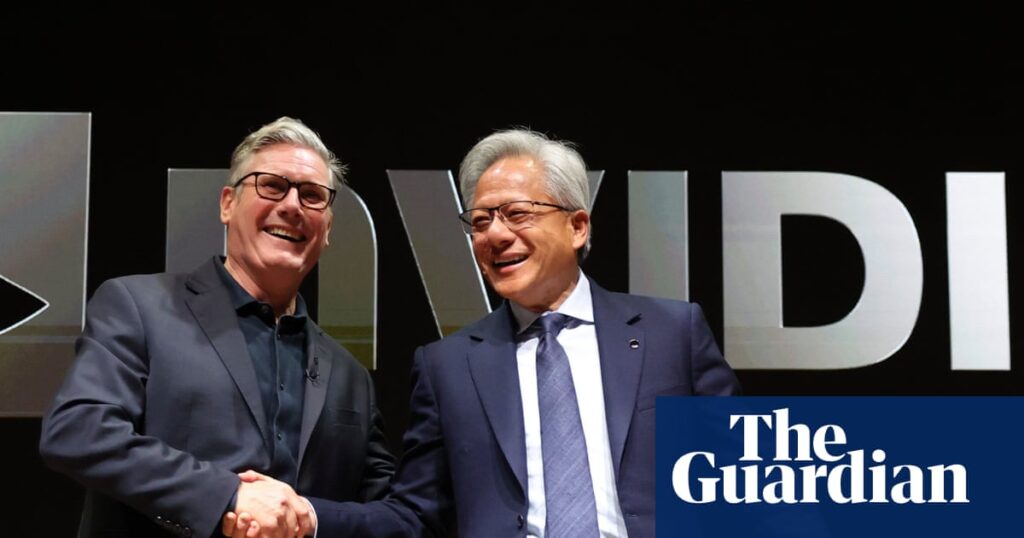

When the billionaire chief executive of AI chipmaker Nvidia threw a party in central London for Donald Trump’s state visit in September, the power imbalance between Silicon Valley and British politicians was vividly exposed.
Jensen Huang hastened to the stage after meetings at Chequers and rallied his hundreds of guests to cheer on the power of AI. In front of a huge Nvidia logo, he urged the venture capitalists before him to herald “a new industrial revolution”, announced billions of pounds in AI investments and, like Willy Wonka handing out golden tickets, singled out some lucky recipients in the room.
“If you want to get rich, this is where you want to be,” he declared.
But his biggest party trick was a surprise guest waiting in the wings. At Huang’s cue, the British prime minister, Keir Starmer, walked out as the crowd whooped at Huang’s pulling power.
Starmer, looking slightly dazed, saluted his host’s “absolutely phenomenal” presentation, told the audience about how he had been “texting away” with Huang and effusively thanked one of the world’s richest men for his “confidence in what we are doing, in your investment, your foresight”. Huang sent him away with a gift: an inscribed AI processing unit.
Not done, Huang called to the stage Liz Kendall, the secretary of state for science, innovation and technology, followed by Peter Kyle, the secretary of state for business. The parade of British cabinet ministers at this private Nvidia event spoke volumes about how successfully US tech oligarchs have pulled British politicians – serving and former – into their orbit.
This week, they landed another big fish. The $500bn ChatGPT maker, Open AI, hired the former chancellor of the exchequer George Osborne, prompting him to gush he was joining “the most exciting and promising company in the world”.
He was just the latest senior figure to pass through the revolving door between Westminster and Silicon Valley. In October, the former Conservative prime minister Rishi Sunak took advisory roles with Anthropic, one of OpenAI’s main rivals, and with Microsoft, which has invested heavily in both AI startups. Liam Booth-Smith, Sunak’s chief of staff, who sits in the House of Lords, also this summer took a senior role at Anthropic after it signed a memorandum of understanding with the UK government.
They followed the former Liberal Democrat deputy prime minister Nick Clegg, who spent seven years leading public affairs for Mark Zuckerberg at Meta, which runs Instagram and Facebook. Clegg is now an AI investor who last week predicted “we will move from staring at the internet to living in the internet”. He made tens of millions of dollars at Meta. Some reports said as much as $100m. He would not confirm that, but said he was paid “extremely well”.
Meanwhile, Tony Blair, prime minister for a decade until 2007, is becoming increasingly influential on technology policy, lobbying successfully, through his Tony Blair…
Source link
Disclaimer
We strive to uphold the highest ethical standards in all of our reporting and coverage. We blogs.grocliq.com want to be transparent with our readers about any potential conflicts of interest that may arise in our work. It’s possible that some of the investors we feature may have connections to other businesses, including competitors or companies we write about. However, we want to assure our readers that this will not have any impact on the integrity or impartiality of our reporting. We are committed to delivering accurate, unbiased news and information to our audience, and we will continue to uphold our ethics and principles in all of our work. Thank you for your trust and support.
Website Upgradation is going on for any glitch kindly connect at [email protected]