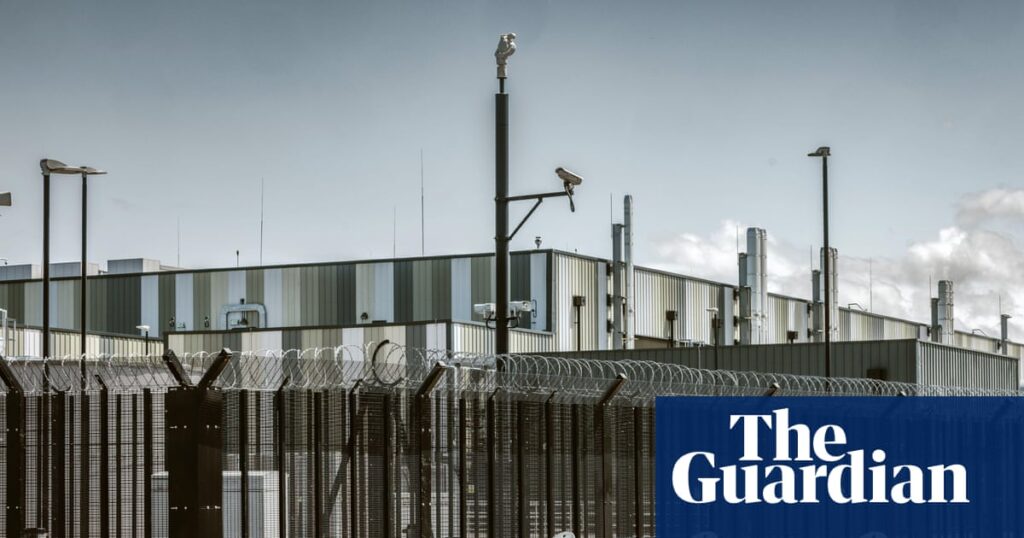

The AI boom has caused as much carbon dioxide to be released into the atmosphere in 2025 as emitted by the whole of New York City, it has been claimed.
The global environmental impact of the rapidly spreading technology has been estimated in research published on Wednesday, which also found that AI-related water use now exceeds the entirety of global bottled-water demand.
The figures have been compiled by the Dutch academic Alex de Vries-Gao, the founder of Digiconomist, a company that researches the unintended consequences of digital trends. He claimed they were the first attempt to measure the specific effect of artificial intelligence rather than datacentres in general as the use of chatbots such as OpenAI’s ChatGPT and Google’s Gemini soared in 2025.
The figures show the estimated greenhouse gas emissions from AI use are also now equivalent to more than 8% of global aviation emissions. His study used technology companies’ own reporting and he called for stricter requirements for them to be more transparent about their climate impact.
“The environmental cost of this is pretty huge in absolute terms,” he said. “At the moment society is paying for these costs, not the tech companies. The question is: is that fair? If they are reaping the benefits of this technology, why should they not be paying some of the costs?”
De Vries-Gao found that the 2025 carbon footprint of AI systems could be as high as 80m tonnes, while the water used could reach 765bn litres. He said it was the first time AI’s water impact had been estimated and showed that AI water use alone was more than a third higher than previous estimates of all datacentre water use.
The figures are published in the academic journal Patterns. The International Energy Agency (IEA) said earlier this year that AI-focused datacentres draw as much electricity as power-thirsty aluminium smelters and datacentre electricity consumption is expected to more than double by 2030.
“This is yet more evidence that the public is footing the environmental bill for some of the richest companies on Earth,” said Donald Campbell, the director of advocacy at Foxglove, a UK non-profit that campaigns for fairness in tech. “Worse, it is likely just the tip of the iceberg. The datacentre construction frenzy, driven by generative AI, is only getting started.
“Just one of these new ‘hyperscale’ facilities can generate climate emissions equivalent to several international airports. And in the UK alone, there are an estimated 100-200 of them in the planning system.”
The IEA has reported that the largest AI-focused datacentres being built today will each consume as much electricity as 2m households with the US accounting for the largest share of datacentre electricity consumption (45%) followed by China (25%) and Europe (15%).
The largest datacentre being planned in the UK, at a former coal power station site in Blyth, Northumberland, is expected to emit more than 180,000 tonnes of CO2 a year when at…
Source link
Disclaimer
We strive to uphold the highest ethical standards in all of our reporting and coverage. We blogs.grocliq.com want to be transparent with our readers about any potential conflicts of interest that may arise in our work. It’s possible that some of the investors we feature may have connections to other businesses, including competitors or companies we write about. However, we want to assure our readers that this will not have any impact on the integrity or impartiality of our reporting. We are committed to delivering accurate, unbiased news and information to our audience, and we will continue to uphold our ethics and principles in all of our work. Thank you for your trust and support.
Website Upgradation is going on for any glitch kindly connect at [email protected]