
By Navneet Sharma
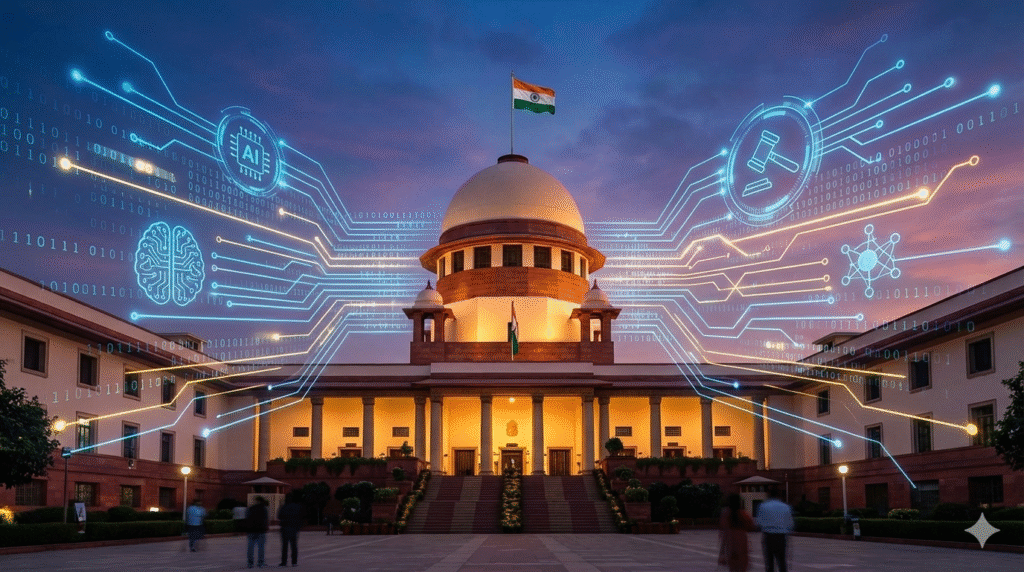
India’s aspiration to become a Viksit Bharat by 2047 is fundamentally an institutional project. While infrastructure, manufacturing, innovation, and human capital dominate public discourse, the quiet backbone of a developed economy is the ability of its institutions to deliver outcomes predictably, fairly, and at scale. Among these institutions, the judiciary occupies a uniquely central position. Courts shape market confidence, social stability, investment behaviour, and the lived experience of constitutional rights. In this context, the Supreme Court of India’s White Paper on Artificial Intelligence and Judiciary, published in November 2025, represents a timely and consequential intervention in India’s development journey.
The White Paper does not frame artificial intelligence (AI) as a futuristic indulgence or a disruptive threat. Instead, it situates AI as a practical response to an undeniable reality: the sheer scale and complexity of India’s judicial workload. The National Judicial Data Grid (NJDG), one of the most consequential digital public goods created under the e-Courts Mission Mode Project, offers stark empirical grounding to this reality. According to NJDG dashboards, India’s courts collectively carry a pendency of over five crore cases. Nearly nine out of every ten of these cases are pending in district courts. A significant proportion of this backlog has remained unresolved for more than three years, with criminal cases accounting for the majority of total pendency. This data reveals that India’s judicial challenge is not merely one of judicial strength, but of administrative capacity, information management, and process design.
Digitisation over the last two decades has delivered meaningful improvements. E-filing, electronic cause lists, online access to judgments, and real-time pendency dashboards have enhanced transparency and reduced friction. NJDG itself is a landmark achievement, transforming judicial data from fragmented silos into a nationally visible, real-time system. Yet digitisation alone, as the White Paper correctly recognises, cannot resolve the deeper structural constraints of scale, diversity, and complexity. Artificial intelligence represents the next logical layer in this evolution: intelligence built upon infrastructure, analytics layered over data, and decision support embedded within administrative workflows.
Why addressing judicial delay matters?
The consequences of judicial delay extend far beyond courtrooms. From an economic perspective, prolonged litigation undermines India’s ability to enforce contracts efficiently, a factor that has historically depressed India’s performance in global investment climate indicators. Even as India has improved insolvency resolution timelines after the enactment of the Insolvency and Bankruptcy Code, NJDG data shows that execution proceedings, recovery suits, and commercial disputes continue to languish at the trial…
Source link
Disclaimer
We strive to uphold the highest ethical standards in all of our reporting and coverage. We blogs.grocliq.com want to be transparent with our readers about any potential conflicts of interest that may arise in our work. It’s possible that some of the investors we feature may have connections to other businesses, including competitors or companies we write about. However, we want to assure our readers that this will not have any impact on the integrity or impartiality of our reporting. We are committed to delivering accurate, unbiased news and information to our audience, and we will continue to uphold our ethics and principles in all of our work. Thank you for your trust and support.
Website Upgradation is going on for any glitch kindly connect at [email protected]