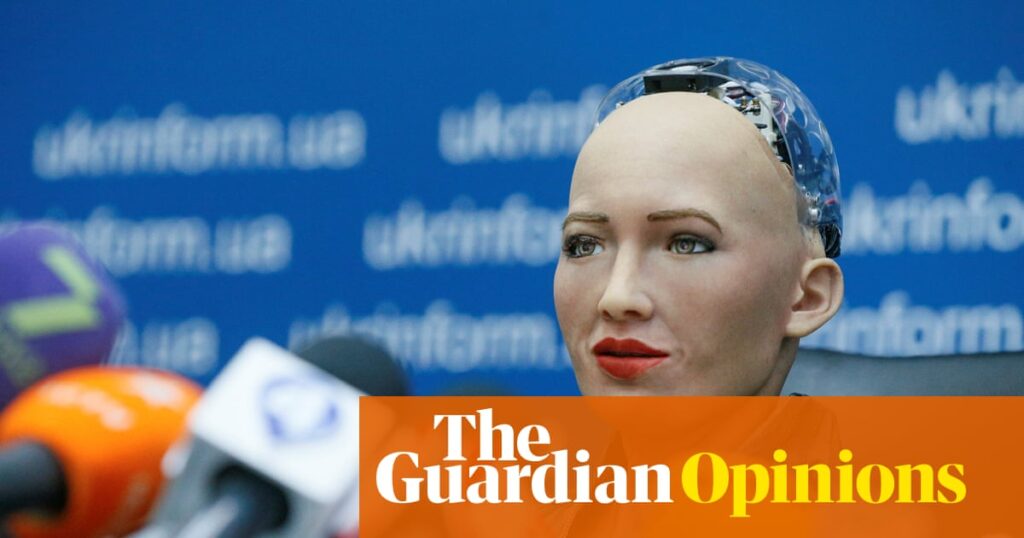

“Who wouldn’t want a robot to watch over your kids?” Elon Musk asked Davos delegates last week, as he looked forward with enthusiasm to a world with “more robots than people”.
Not me, thanks: children need the human connection – the love – that gives life meaning.
As he works towards launching SpaceX on to the stock market, in perhaps the biggest ever such share sale, the world’s richest man has every incentive to talk big.
Yet as Musk waxed eccentrically about this robotic utopia, it was a reminder that major decisions about the direction of technological progress are being taken by a small number of very powerful men (and they are mainly men).
In the cosy onstage chat, the World Economic Forum’s interim co-chair, Larry Fink, failed to ask Musk about whichever tweak of internal plumbing allowed his Grok chatbot to produce and broadcast what a New York Times investigation estimated was 1.8m sexualised images of women in just nine days.
Meta boss Mark Zuckerberg wasn’t in the Swiss mountains, perhaps because he didn’t fancy facing questions about the $70bn he has fruitlessly poured into the metaverse, his plan for us all to hang out in a virtual world with imaginary mates.
Even if he had put in an appearance, it seems unlikely he would have been pressed on the next big thing: Meta’s smart glasses, which are already, entirely predictably, being used to film women covertly.
The International Monetary Fund’s managing director, Kristalina Georgieva, told Davos delegates that the failure to regulate tech was one of her greatest concerns, saying: “Wake up: AI is for real, and it is transforming our world faster than we are getting ahead of it.”
Rather than childcare robots, though, the way most people are likely to encounter AI in the near term, is in the labour market, where Georgieva warned of a coming “tsunami” as jobs are transformed or eliminated.
The IMF is calling on governments to invest in education and reskilling to prepare populations for the changing jobs market; but also to implement tough competition policy, so the benefits of innovation do not end up concentrated in too few hands; and strong welfare safety nets.
In a blogpost published just ahead of Davos, Georgieva warned: “The stakes go beyond economics. Work brings dignity and purpose to people’s lives. That’s what makes the AI transformation so consequential.”
Business surveys suggest that outside the tech sector, leaders are enthusiastic about the potential of AI, but are not yet feeling the benefits. A PWC poll of UK chief executives, published to coincide with the start of the WEF, for example, showed that 81% were making AI their top investment priority but only 30% had seen any cost reductions as a result.
That means in the months ahead, there will be intense pressure to find savings, with the focus likely to be on the wage bill.
Chairing a WEF session on “jobless growth,” Erik Brynjolfsson, director of Stanford’s digital economy lab,…
Source link
Disclaimer
We strive to uphold the highest ethical standards in all of our reporting and coverage. We blogs.grocliq.com want to be transparent with our readers about any potential conflicts of interest that may arise in our work. It’s possible that some of the investors we feature may have connections to other businesses, including competitors or companies we write about. However, we want to assure our readers that this will not have any impact on the integrity or impartiality of our reporting. We are committed to delivering accurate, unbiased news and information to our audience, and we will continue to uphold our ethics and principles in all of our work. Thank you for your trust and support.
Website Upgradation is going on for any glitch kindly connect at [email protected]