
Wesley Hartwell raised his fists to the barista and shook them next to his ears. He then lowered his fists, extended his thumbs and little fingers, and moved them up and down by his chest, as though milking a cow. Finally, he laid the fingers of one hand flat on his chin and flexed his wrist forward.
Hartwell, who has no hearing problems, had just used BSL, British Sign Language, to order his morning latte with normal milk at the deaf-run Dialogue Cafe, based at the University of East London, and thanked Victor Olaniyan, the deaf barista.
“I have to be honest: when this cafe first opened near my office, I avoided it because the whole idea made me anxious,” said Hartwell, a lecturer at the university. “But now I’m fascinated. Sign language is amazing. I’m thinking of taking a course so I can learn more.”
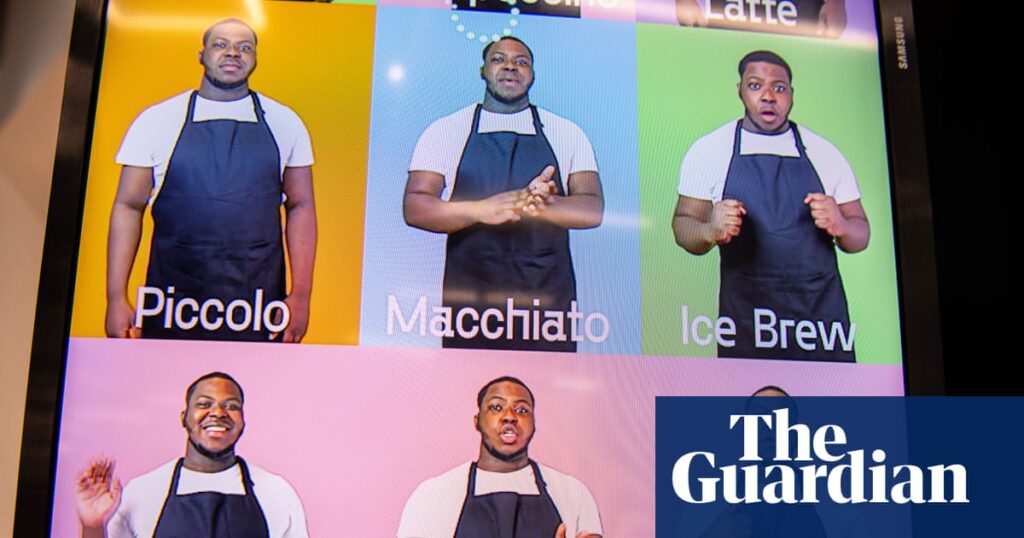
What gave Hartwell the confidence to try BSL was the cafe’s touchscreen menu. Instead of just listing the coffees and cakes on sale, the menus show videos of their BSL translation.
For many deaf BSL users, this kind of direct access is crucial. BSL is a first language for tens of thousands of people in the UK.
Olaniyan, who has worked at the cafe for five years and now does shifts alongside a degree in accounting and management at the University of Reading, seemed mildly amused by the reactions of hearing people to the video menu.
“I was brought up by hearing people, so I have no problem in the hearing world,” he signed. “But hearing people often feel anxious communicating with us. If this technology helps them, that’s great, but I’m fine as I am.”
In the past two years, there has been an explosion of digital and AI-linked products aiming to bridge communication barriers between the deaf and hearing worlds, from signing avatars to large generative models that aspire to rival mainstream AI platforms.
Independent evaluations of many of these systems remain limited, however, and sign languages researchers caution that current tools still struggle with linguistic nuance, regional variation and context, particularly in high-stakes settings such as healthcare and law.
But the ambitions are striking: the UK startup Silence Speaks has built an avatar-based system that converts text into BSL, claiming it can convey contextual meaning and emotional cues.
The British project SignGPT, backed by £8.45m in funding, is developing models to translate between BSL and English in both directions, while also building what it describes as the largest sign languages dataset in the world.
Sign languages AI research has also become increasingly collaborative and international: a new £3.5m UK-Japan research project is developing systems trained on natural deaf-to-deaf conversation data rather than interpreter recordings.
Much of this recent progress has come quickly. When Prof Bencie Woll, co-investigator of the SignGPT project at University College London’s Deafness,…
Source link
Disclaimer
We strive to uphold the highest ethical standards in all of our reporting and coverage. We blogs.grocliq.com want to be transparent with our readers about any potential conflicts of interest that may arise in our work. It’s possible that some of the investors we feature may have connections to other businesses, including competitors or companies we write about. However, we want to assure our readers that this will not have any impact on the integrity or impartiality of our reporting. We are committed to delivering accurate, unbiased news and information to our audience, and we will continue to uphold our ethics and principles in all of our work. Thank you for your trust and support.
Website Upgradation is going on for any glitch kindly connect at [email protected]