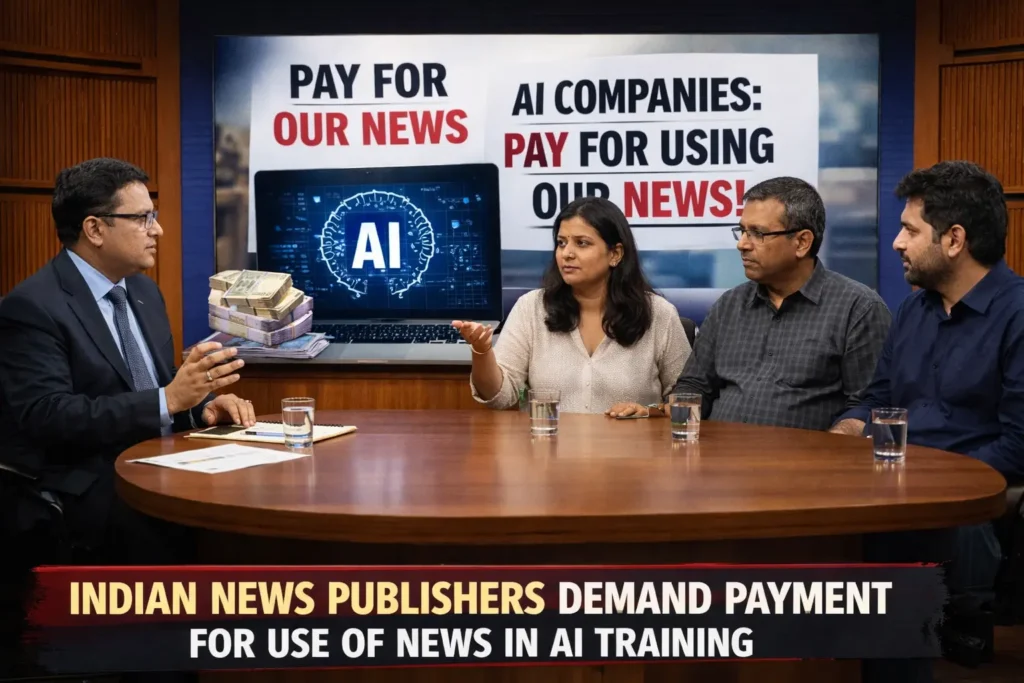

“Journalistic content is not like free-floating content on the internet. It is intellectual property…data has to be contracted. It cannot be surrendered,” said Mohit Jain, Chief Operating Officer and Member of the Board, Bennett, Coleman & Co. Ltd, at one of the discussions at the India AI Impact Summit (2026) on February 16, 2026.
Several Indian news publishers have raised concerns that AI companies are extracting high-value journalistic content without any licensing fees, warning that such a practice can threaten the foundation of news, particularly its sustainability as a business model.
Why News is More than Just ‘Content’?
Along with Jain, all speakers at the discussion agreed that stakeholders should treat news differently from regular online content. They argued that the nature of news and its value in a democracy set it apart from general content.
“They are different forms of content, but they do not impact society in the same way, like a film, a documentary, or a story. But journalism is something else. You have to take a lot of care,” said Jain. Continuing further, he said, “The Press is not just something which produces information. It curates trust. It provides context. And it accepts the moral and legal responsibility for what it publishes. That layer of accountability is the differentiator. And when AI begins to commoditise information, trust will become scarce.”
Highlighting the untrustworthy information that AI is generating, India Today Group’s Vice Chairperson, Kalli Purie, said, “AI is not creating accountable information. In fact, what AI is creating is slop that creates an illusion of trust, which is problematic.”
She further said that AI systems shouldn’t shape public opinion. “News and verified media brands such as the Times of India and the India Today Group shape opinion. In a country like ours, where literacy rates are not uniformly high, you want verified outlets having that power to shape public opinion.”
Nine Points on what AI companies need to do:
While various speakers offered their opinions on what can be done to protect the future of media, India Today Group’s Vice Chairperson, Purie, laid out a nine-point charter for AI companies to follow to make AI “benign.”
- Fair value for journalistic content used in AI systems. The public needs transparency on how AI companies are digesting and metabolising news in AI models.
- Attribution and traceability as a democratic principle, not as a commercial favour that the big giants are doing to the public.
“Why are tech companies not making it part of the code that you cannot use AI without it labelling content automatically? Why is this left to the discretion of the user? Bad actors are never going to declare it’s AI-generated. You’re just putting more responsibility on the good actors and not controlling the bad actors,” she said.
- Recognise journalism as a public good.
- Reward…
Source link
Disclaimer
We strive to uphold the highest ethical standards in all of our reporting and coverage. We blogs.grocliq.com want to be transparent with our readers about any potential conflicts of interest that may arise in our work. It’s possible that some of the investors we feature may have connections to other businesses, including competitors or companies we write about. However, we want to assure our readers that this will not have any impact on the integrity or impartiality of our reporting. We are committed to delivering accurate, unbiased news and information to our audience, and we will continue to uphold our ethics and principles in all of our work. Thank you for your trust and support.
Website Upgradation is going on for any glitch kindly connect at [email protected]