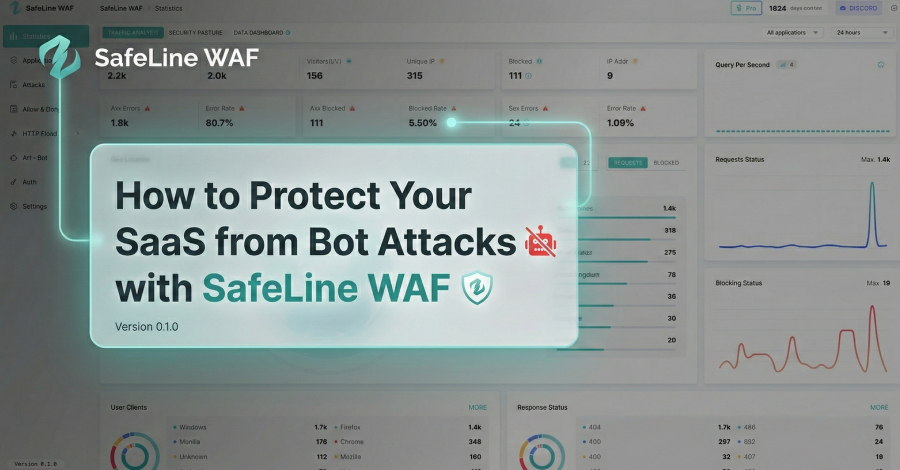


Most SaaS teams remember the day their user traffic started growing fast. Few notice the day bots started targeting them.
On paper, everything looks great: more sign-ups, more sessions, more API calls. But in reality, something feels off:
- Sign-ups increase, but users aren’t activating.
- Server costs rise faster than revenue.
- Logs are filled with repeated requests from strange user agents.
If this sounds familiar, it’s not just a sign of popularity. Your app is under constant automated attack, even if no ransom emails have arrived. Your load balancer sees traffic. Your product team sees “growth”. Your database sees pain.
This is where a WAF like SafeLine fits in.
SafeLine is a self-hosted web application firewall (WAF) that sits in front of your app and inspects every HTTP request before it reaches your code.
It does not just look for broken packets or known bad IPs. It watches how traffic behaves: what it sends, how fast, in what patterns, and against which endpoints.
In this article, we’ll show what real attacks look like for a SaaS product, how bots exploit business logic, and how SafeLine can protect your app without adding extra work for your team.
The Attacks SaaS Products Actually See
When people say “web attacks”, many think only about SQL injection or XSS. Those still exist, and SafeLine blocks them with a built‑in Semantic Analysis Engine.
SafeLine’s Semantic Analysis Engine reads HTTP requests like a security engineer. Instead of just hunting keywords, it understands context, decoding payloads, spotting weird field types, and recognizing attack intent across SQL, JS, NoSQL, and modern frameworks. Blocks sophisticated bots and zero-days with 99.45% accuracy and no constant rule tweaks needed.
 |
| Malicious Requests Blocked by SafeLine |
But for SaaS, the most painful attacks are not always the most “technical”. They are the ones that bend your business rules.
Common examples:
- Fake sign‑ups: Automated sign‑up scripts farm free trials, burn invitation codes, or harvest discount coupons.
- Credential stuffing: Bots try leaked username/password pairs against your login endpoint until something works.
- API scraping: Competitors or generic scrapers walk your API, page by page, copying your content or pricing.
- Abusive automation: One user (or botnet) triggers heavy background jobs, export tasks, or webhook storms that you pay for.
- Bot traffic spikes: Sudden waves of scripted requests hit the same endpoints, not big enough to be a classic DDoS, but enough to slow everything down.
The tricky part is that all these requests look “normal” at the HTTP level.
They are:
- Well‑formed
- Often over HTTPS
- Using your documented API
Why a Self‑Hosted WAF Makes Sense for SaaS
There are many cloud WAF products. They work well for a lot of teams. But SaaS products have some special concerns:
- Data control: You may not want every request and response to flow through another company’s cloud.
- Latency and routing: Extra…
Source link
Disclaimer
We strive to uphold the highest ethical standards in all of our reporting and coverage. We blogs.grocliq.com want to be transparent with our readers about any potential conflicts of interest that may arise in our work. It’s possible that some of the investors we feature may have connections to other businesses, including competitors or companies we write about. However, we want to assure our readers that this will not have any impact on the integrity or impartiality of our reporting. We are committed to delivering accurate, unbiased news and information to our audience, and we will continue to uphold our ethics and principles in all of our work. Thank you for your trust and support.
Website Upgradation is going on for any glitch kindly connect at [email protected]