
Wilmington, Ohio, resident Quintin Koger Kidd was so concerned last June with his local public officials’ alleged misdoings – open meeting violations and other discrepancies – that he filed a complaint in court to have the mayor and city council members removed from their posts.
When Koger Kidd later heard that the city supported plans by Amazon Web Services to build a $4bn datacenter on 500 acres (200 hectares) south of town, he was aghast. Amazon has sought a tax abatement that would see its datacenter exempt from paying property taxes for 30 years in exchange for the funding of local schools and infrastructure projects.
“The people up on city council are, for the most part, good people. They care about the community, [but] they have been taken advantage of by these companies,” he says, referencing the multinational giant. “They’re in over their heads … It’s the digital colonization of flyover states.”
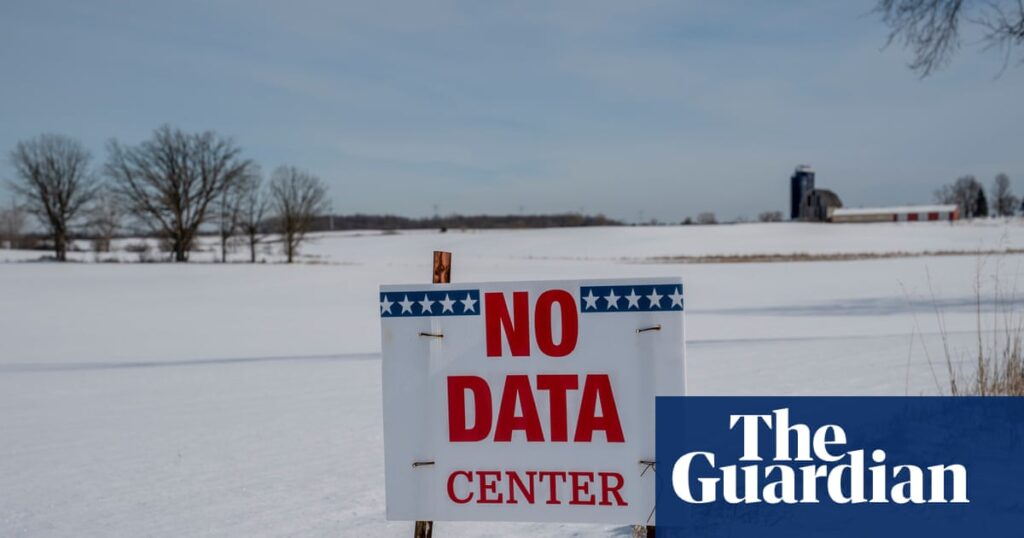
For decades, administering small towns and communities in the US largely centered on zoning amendments, fixing roads and ensuring that trash was collected. But today, the emerging presence of datacenter developments is creating a vicious new divide between local administrators, who play an essential role in rural America, and the residents they are elected to represent.
In small towns across the US, residents are accusing local representatives of a wave of issues that range from failing to listen to public concern and profiting from the presence of datacenters, resulting in a deepening distrust in local government.
In December, three people were arrested at a city council meeting in Port Washington, Wisconsin, after a brawl erupted around a proposed datacenter in the community of 12,000 people. A month earlier, police escorts were required at a council meeting discussing datacenters in DeKalb county, Georgia.
The boiling anger is prompting a crisis in local government circles.
Late last year, the mayor and a council member of Ashville, a small town south of Columbus, Ohio, resigned abruptly after residents recoiled at the prospect of a new facility being built locally by EdgeConneX, a Virginia-headquartered datacenter company. The resignations leave the village of fewer than 5,000 residents without much-needed administrative experience.
Similar stories are playing out in small towns in Minnesota, Michigan, Oregon and elsewhere, where officials and administrators with decades of experience and who are oftentimes paid very little, are walking off the job due to acrimony fueled by datacenters.
When the municipal leaders of Saline Township, a rural community of 2,270 people south of Ann Arbor in Michigan, voted last September against rezoning a tract of agricultural land sought by a developer representing the tech giants Oracle and OpenAI, residents thought that was the end of the threat of a massive datacenter dominating their community.
But they and their fellow residents were almost immediately proved wrong.
Within weeks, lawyers for…
Source link
Disclaimer
We strive to uphold the highest ethical standards in all of our reporting and coverage. We blogs.grocliq.com want to be transparent with our readers about any potential conflicts of interest that may arise in our work. It’s possible that some of the investors we feature may have connections to other businesses, including competitors or companies we write about. However, we want to assure our readers that this will not have any impact on the integrity or impartiality of our reporting. We are committed to delivering accurate, unbiased news and information to our audience, and we will continue to uphold our ethics and principles in all of our work. Thank you for your trust and support.
Website Upgradation is going on for any glitch kindly connect at [email protected]