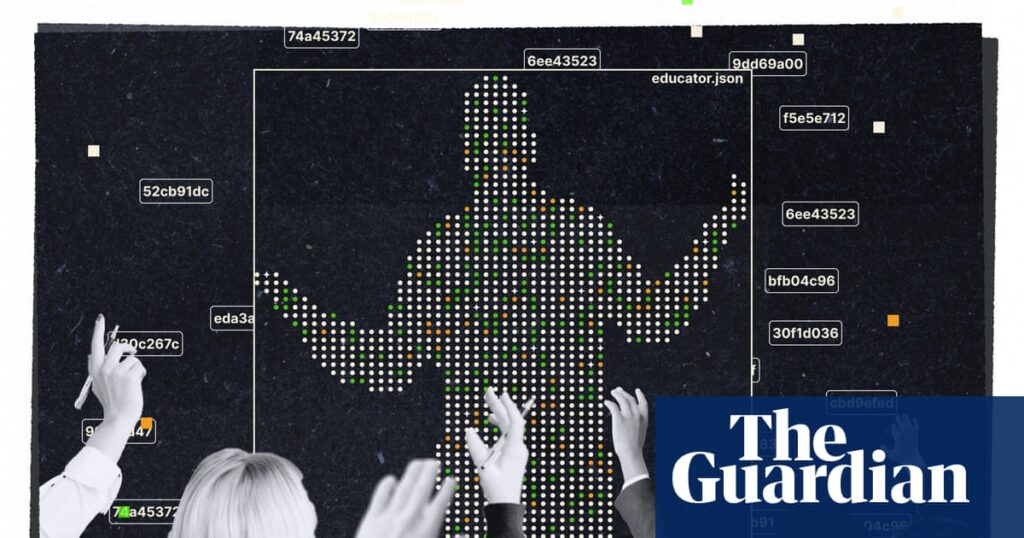

Two years ago, at the age of 39, I began training to be a school teacher. I wanted to teach English – to help young people become stronger readers, writers and thinkers, with a deeper connection to literature. After 15 years of working as a freelance writer and as a novelist, I felt confident that I had something to offer. But the further I progressed in my training, the more uncertain I felt. One particular question taunted me for my lack of an answer. What to do about artificial intelligence?
The immediate dilemma: what does it mean for English instruction that all pupils now have access to free online chatbots that can produce fluid, fairly complex prose on demand? This question sits atop a teetering pile of timeless pedagogical quandaries: What are we actually trying to do in school? How should we go about doing it? How do we know if we’ve succeeded? I was a newcomer, negotiating all of this for the first time. Throwing AI into the mix felt like downing a coffee in the middle of a panic attack.
I started frantically seeking out perspectives on AI and the English classroom wherever I could find them: pedagogy podcasts, pedagogy Substacks, pedagogy YouTube channels. My algorithmic feeds picked up on this interest and started catering to it, serving me an apparently endless supply of content – including endless advertising from tech companies – that promised to help me think through these urgent questions and ensure I did right by my students.
I quickly learned that this was a world of heated, often acrimonious, debate. On one side (to simplify a bit) were the AI rejectionists: teachers and education pundits for whom AI was nothing less than an existential assault by rapacious tech companies on the defining activities of the classroom. What students needed, they argued, was to learn how to push themselves through difficulty: to read complex texts and develop complex arguments. They needed to learn that these were processes full of friction and uncertainty, and they needed to learn how to embrace that fact, rather than running away from it. Access to a one-click writing machine made it too easy to run away.
AI rejectionists shared horror stories of students handing in AI-generated papers about which they couldn’t answer the simplest questions, or citing nonexistent sources their chatbots had “hallucinated”. They posted studies suggesting that chatbot use dulled students’ reasoning faculties, or even impeded the physical development of their brain. They raised ethical concerns, including AI’s environmental costs, chatbots’ reliance on copyrighted writing, and the oligarchal leanings of big tech companies. For most rejectionists, the solution was to build a classroom that AI couldn’t touch. They talked about shifting toward in-class essays, perhaps written by hand. They debated the feasibility of reviving oral tests and quizzes.
On the other side were the AI cheerleaders. I’m not talking about their crazy uncles, the mostly…
Source link
Disclaimer
We strive to uphold the highest ethical standards in all of our reporting and coverage. We blogs.grocliq.com want to be transparent with our readers about any potential conflicts of interest that may arise in our work. It’s possible that some of the investors we feature may have connections to other businesses, including competitors or companies we write about. However, we want to assure our readers that this will not have any impact on the integrity or impartiality of our reporting. We are committed to delivering accurate, unbiased news and information to our audience, and we will continue to uphold our ethics and principles in all of our work. Thank you for your trust and support.
Website Upgradation is going on for any glitch kindly connect at [email protected]