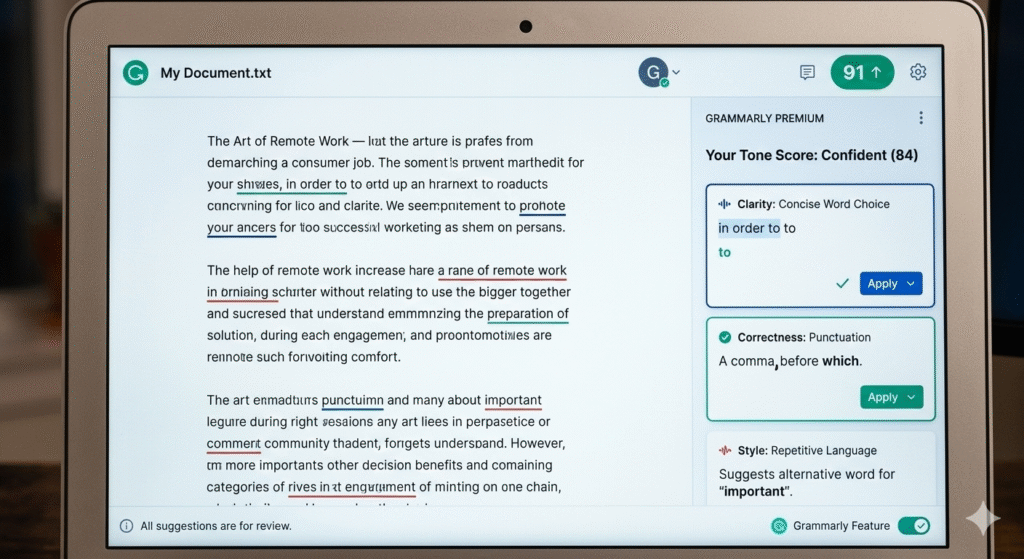

Grammarly’s AI-powered “Expert Review” feature attributes its writing suggestions to prominent individuals and claims that it draws on their advice. However, these individuals may not be aware that the grammar-correction tool is associating their names and credentials with its suggestions.
When MediaNama tested this feature, it referenced several individuals. These included MediaNama’s Editor Nikhil Pahwa, Pranesh Prakash, Principal Consultant at Anekaanta, and Sunil Abraham, co-founder of Centre for Internet and Society (CIS), among others.

Without any external user prompts, Grammarly voluntarily suggests edits from the “subject matter experts.”
However, a small legal disclaimer at the bottom clarifies :
“References to experts in this product are for informational purposes only and do not indicate any affiliation with Grammarly or endorsement by those individuals or entities.”

What are Grammarly’s AI Agents? They are proactive, autonomous AI systems that can independently work toward specific goals, with contextual awareness and the ability to perform multi-step reasoning.
Grammarly claims that its AI agents could:
- Get expert feedback,
- Predict reader reactions,
- Strengthen arguments,
- Predict users’ grades, etc.
Their AI agents include: AI Grader that provides feedback based on course rubrics, a Citation Finder that locates credible sources and generates citations, Expert Review that offers feedback attributed to subject-matter experts, a Humaniser that makes AI-generated text sound more natural, along with tools like a Proofreader, Paraphraser, AI Detector, and Plagiarism Checker.

Personality Rights & Anthropomorphisation: “Pranesh Prakash, Principal Consultant at Anekaanta, a Chennai-based policy advisory firm, in a phone call with MediaNama, there are two major issues with this incident: personality rights and anthropomorphisation.
Anthropomorphisation is the attribution of human characteristics, such as emotions, intentions, or identity, to non-human entities, including animals, machines, and even software. Meanwhile, personality rights protect an individual’s likeness, including their voice, face, style, etc., from unauthorised exploitation.
“Neither of these is necessarily covered under current Indian law. So neither of these is necessarily a legal concern,” he said.
However, “Personality rights are recognised in India, but they are not uniform,” he added, citing the recent judgements from various courts that guarded the personality rights of various celebrities.
He warned that anthropomorphising AI, such as giving it a human identity or name, could lead people to treat it like a human and cause negative psychological effects and unforeseen long-term consequences.
It shouldn’t be legal to use a name to promote their services: “They are making use…
Source link
Disclaimer
We strive to uphold the highest ethical standards in all of our reporting and coverage. We blogs.grocliq.com want to be transparent with our readers about any potential conflicts of interest that may arise in our work. It’s possible that some of the investors we feature may have connections to other businesses, including competitors or companies we write about. However, we want to assure our readers that this will not have any impact on the integrity or impartiality of our reporting. We are committed to delivering accurate, unbiased news and information to our audience, and we will continue to uphold our ethics and principles in all of our work. Thank you for your trust and support.
Website Upgradation is going on for any glitch kindly connect at [email protected]