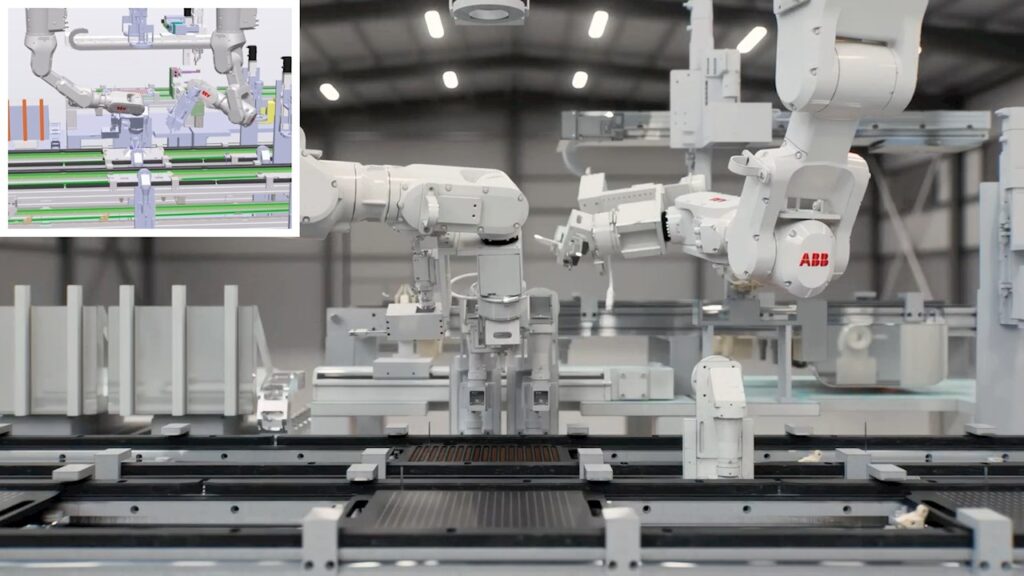

A new ABB and NVIDIA partnership shows physical AI simulation is driving real ROI in factory automation and solving production hurdles.
Manufacturers have often found it difficult to make intelligent robotics work reliably outside testing environments. The core issue is the gap between digital training models and actual factory floors, where lighting, material physics, and part variations refuse to behave as they do on a screen.
Historically, this friction has previously forced engineering teams to fall back on physical prototypes, delaying product launches and driving up costs.
Overcoming the digital to physical AI simulation divide
The partnership between ABB Robotics and NVIDIA attempts to close this gap by bringing industrial-grade physical AI to manufacturing facilities. Slated for release in the second half of 2026, RobotStudio HyperReality is already drawing interest from a global customer base.
By embedding NVIDIA Omniverse libraries within its existing RobotStudio software, ABB provides a platform for physically accurate digital testing. On an operational level, this integration allows engineers to cut deployment costs by up to 40 percent and accelerate time to market by as much as 50 percent.
Realising these efficiency gains demands a workflow where production leaders design, test, and validate complete automation cells before installing any hardware. To do this, the system exports a fully parameterised station – encompassing the robots, sensors, lighting, kinematics, and parts – as a USD file straight into the Omniverse environment.
Inside this digital space, a virtual controller runs the identical firmware found on the physical machine, enabling a 99 percent behavioural match between the digital and physical realms.
Rather than manually programming movements, computer vision models learn using synthetic images generated inside the software. When combined with Absolute Accuracy technology, this method cuts positioning errors down from 8-15 mm to approximately 0.5 mm, providing high precision for industrial applications.
Marc Segura, President of ABB Robotics, said: “Combining RobotStudio with the physically accurate simulation power of NVIDIA Omniverse libraries, we have closed technology’s long-standing ‘sim-to-real’ gap—a huge milestone to deploying physical AI with industrial-grade precision, for real-world customer applications.”
Validating factory automation before deployment
Early adopters are already validating these capabilities on active production lines.
Foxconn, for example, is testing the software for consumer device assembly—an area where frequent product changes and delicate metal components complicate traditional automation. By generating synthetic data to train their systems virtually, Foxconn achieves high accuracy on the factory floor while anticipating a reduction in setup time and the elimination of costly physical testing.
Similarly, Workr – a…
Source link
Disclaimer
We strive to uphold the highest ethical standards in all of our reporting and coverage. We blogs.grocliq.com want to be transparent with our readers about any potential conflicts of interest that may arise in our work. It’s possible that some of the investors we feature may have connections to other businesses, including competitors or companies we write about. However, we want to assure our readers that this will not have any impact on the integrity or impartiality of our reporting. We are committed to delivering accurate, unbiased news and information to our audience, and we will continue to uphold our ethics and principles in all of our work. Thank you for your trust and support.
Website Upgradation is going on for any glitch kindly connect at [email protected]