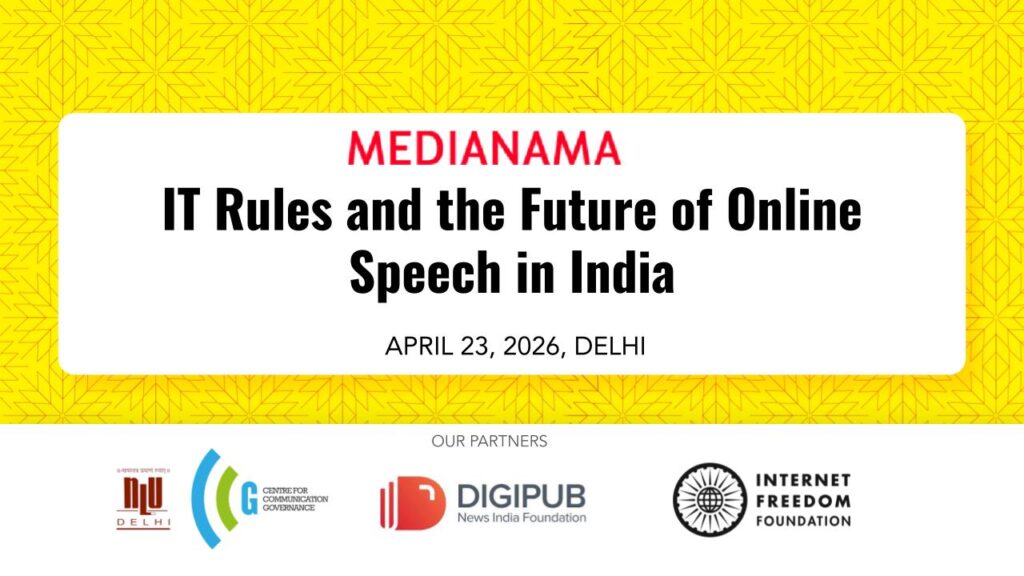

We are pleased to announce the speakers for our discussion “IT Rules and the Future of Online Speech in India.” The event aims to examine the implications of the Ministry of Electronics and Information Technology’s (MeitY) draft amendments to the Information Technology (Intermediary Guidelines and Digital Media Ethics Code) Rules, 2021, including their impact on intermediary liability, safe harbour, and government oversight of online speech.
- Date: April 23, 2026
- Time: 12:30 PM – 5:00 PM (lunch will start 12:30 PM onwards)
- Venue: Gulmohar Hall, India Habitat Centre, New Delhi
Register here (for in-person attendance) | Zoom link (for virtual participation)
Note: The Zoom link is intended for outstation participants only. If you are based in Delhi, please register for in-person attendance.
Brief agenda and Speakers List:
- 12:30 PM – 1:00 PM: Lunch and networking
- 1:00 PM – 1:45 PM: Victims of Censorship in India
- 1:55 PM – 2:45 PM: MeitY’s Expanding Mandate: Rule 3(4), the timelines for content takedowns, and the Safe Harbour, in the context of Shreya Singhal and the IT Act
Speakers:
- Rakesh Maheshwari, Former Sr. Director and Group Coordinator, MeitY
- Apar Gupta, Founder of Internet Freedom Foundation
- Vasudev Devadasan, Lawyer and Master of Law Candidate at University of Melbourne
- Torsha Sarkar, Project Manager at Centre for Communication Governance, NLU Delhi (CCG-NLUD)
3:25 PM – 4:15 PM: MIB’s Expanded Reach: The IDC, Part III, and Government Oversight of News Content and impact on users online
Speakers:
- Sangeeta Barooah Pisharoty, President of Press Council of India
- Sneha Jain, Partner at Saikrishna & Associates
- Abhishek Malhotra, Managing Partner at TMT Practice
Please refer to our curated reading list to get up to speed on the discussion topics: [Reading List] & [Agenda].
What are we discussing?
MeitY has published draft amendments to the IT Rules, 2021, describing them as “clarificatory and procedural in nature.” These amendments expand the scope of executive directions that intermediaries must comply with as a condition for retaining safe harbour under Section 79 of the IT Act, extend regulatory oversight to user-generated news and current affairs content, and enable direct government referrals to the Inter-Departmental Committee without a prior complaint.
Alongside this, recent amendments on synthetically generated information compress takedown timelines to as little as three hours, increasing reliance on automated moderation systems. Taken together, these changes raise important questions around intermediary liability, platform behaviour, and the future of online speech in India.
If you haven’t registered yet, please use the following links and feel free to share them with others who may find them useful.
Register here (for in-person attendance) | Zoom link (for virtual participation)
Note: The Zoom link is intended for…
Source link
Disclaimer
We strive to uphold the highest ethical standards in all of our reporting and coverage. We blogs.grocliq.com want to be transparent with our readers about any potential conflicts of interest that may arise in our work. It’s possible that some of the investors we feature may have connections to other businesses, including competitors or companies we write about. However, we want to assure our readers that this will not have any impact on the integrity or impartiality of our reporting. We are committed to delivering accurate, unbiased news and information to our audience, and we will continue to uphold our ethics and principles in all of our work. Thank you for your trust and support.
Website Upgradation is going on for any glitch kindly connect at [email protected]