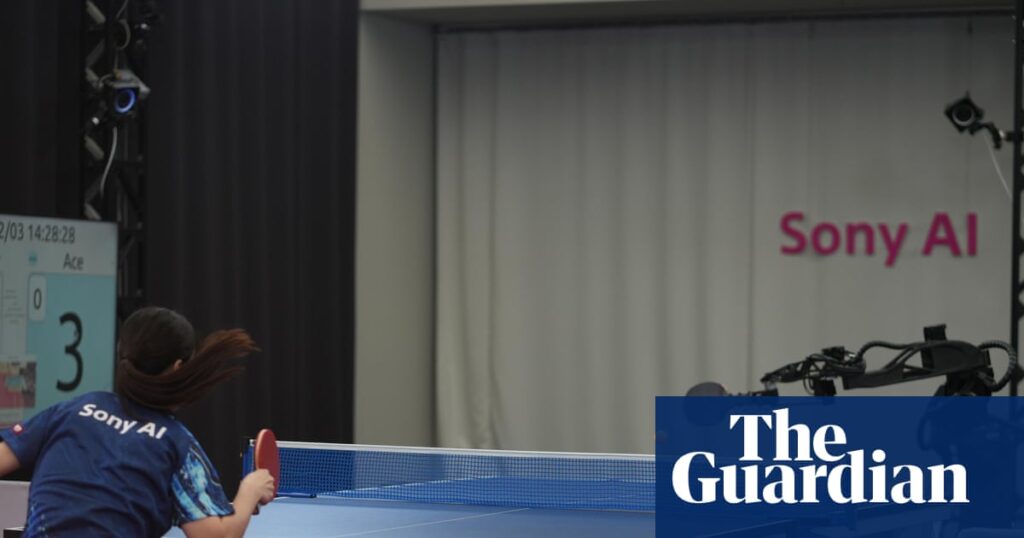

An AI-powered robot has beaten elite players at table tennis in a landmark achievement for a machine faced with human athletes in a real-world competitive sport.
Named Ace, the robotic system developed by Sony AI, won three out of five matches against elite players, but lost the two it played against professionals, clawing back only one game in the seven contests.
The feat has been hailed as a milestone for robotics, a field that has long seen table tennis – and the lightning-fast reactions, perception and skill it demands – as one of the toughest tests of how far the technology has advanced.
In the matches, played under official competition rules, Ace displayed a mastery of spin, handled difficult shots, such as balls catching on the net, and pulled off one rapid backspin shot that a professional had thought impossible.
A research paper on the robot was published in Nature on Wednesday, but scientists working on the project said Ace had improved since the report was submitted. “We played stronger and stronger players and we beat stronger and stronger players,” said Peter Dürr, the director of Sony AI in Zurich and project lead for Ace.
AI researchers use games from chess and go, to poker and Breakout to teach programs on how to make decisions in complex situations. Building an intelligent robot takes the challenge to the next level by requiring the machine to enact decisions effectively.
Ace sidesteps some tricky aspects of table tennis by having an eight-jointed arm on a movable base that does not have to stand on two legs. And instead of seeing the ball with two eyes, it draws on images from multiple cameras that view the entire court from different angles and track the position and spin of the ball.
By zooming in on the ball’s logo, the camera system can estimate the ball’s spin and axis of rotation in the milliseconds it takes to reach Ace’s end of the table. How to deal with spin, and which shots to play, were honed during 3,000 hours of games played in a computer simulation. Other skills, such as serves, were drawn from those used by expert players.
Ace was not a table tennis ace from the start. Early on, it had problems facing slow balls with minimal spin, returning them weakly and being punished for the slip. But it was impressive at tricky shots, such as when the ball catches on the net, with Ace responding extremely quickly to the altered trajectory.
“If I used a serve with complex spin, Ace also returned the ball with complex spin, which made it difficult for me,” said Rui Takenaka, an elite player. “But when I used a simple serve – what we call a knuckle serve – Ace returned a simpler ball. That made it easier for me to attack on the third shot, and I think that was the key reason why I was able to win.”
When Ace played an unusual shot, intercepting the ball early and imparting backspin, the former Olympic table tennis player Kinjiro Nakamura, said it had not thought it possible, but now…
Source link
Disclaimer
We strive to uphold the highest ethical standards in all of our reporting and coverage. We blogs.grocliq.com want to be transparent with our readers about any potential conflicts of interest that may arise in our work. It’s possible that some of the investors we feature may have connections to other businesses, including competitors or companies we write about. However, we want to assure our readers that this will not have any impact on the integrity or impartiality of our reporting. We are committed to delivering accurate, unbiased news and information to our audience, and we will continue to uphold our ethics and principles in all of our work. Thank you for your trust and support.
Website Upgradation is going on for any glitch kindly connect at [email protected]