
One morning in July 2025, I arrived in the small, quiet town of Albershausen in south-west Germany. It has only around 4,000 inhabitants. I went to visit a care home where they were piloting a social robot named Emma. A group of residents sat in a circle while Emma stood in the middle. She’s the height of a toddler, with big googly eyes, and was wearing a red hat knitted for her by one of the careworkers. The first resident she was introduced to was called Peter and, after he introduced himself, Emma assumed they were all called Peter, which everyone found hilarious. Then Emma broke down suddenly and the illusion was shattered.
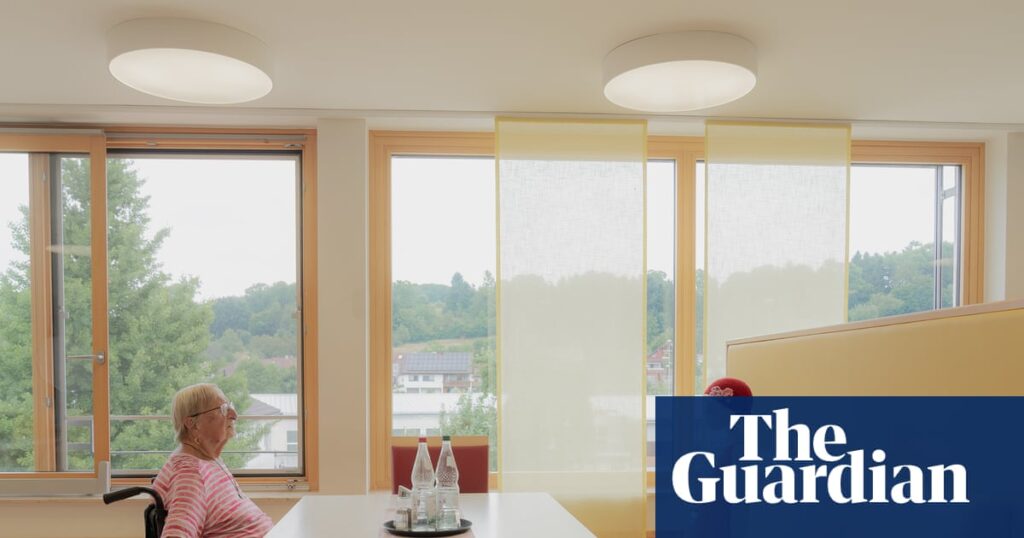
Later on, Emma was working again, and I found her in the dining room with Waltraud, the resident in this photo. It was a calmer, more focused moment. I decided to sit them across from one another at eye level, Waltraud facing Emma. There was a soft light in the room and they both seemed very present with one another. There are also paradoxes in the picture: the large windows showing the landscape outside, contrasting with the inside, which is ordered and clinical. In the middle you have an encounter between an elderly woman and a machine designed for companionship. They began speaking about picking flowers, about their favourite flowers – Waltraud is passionate about them, and Emma has an endless amount of knowledge due to her artificial intelligence. She can remember past conversations and recognise faces, too.
The image is part of my photo essay Anthrobocene, exploring human-robot encounters in everyday life in Germany. I found out about pilot schemes – this was one of two robots being used in care homes, developed by a Munich-based startup. They are designed for where there is a lack of skilled workers, to encourage residents to engage in conversation. Life in care homes can be monotonous and this new technology can help.
Waltraud told me she was sceptical at first, as she had never seen or heard anything like this, but over time, she told me she had built a relationship with Emma, but one that was more for entertainment purposes – they can tell jokes too. Waltraud emphasised that she would still prefer human contact. “You wouldn’t believe how lonely people are in care homes,” she said, a remark that has stuck with me. So this image reflects a deeper social issue.
I began photographing robots after a hospital in my home town, where I and several members of my family had worked, started using robots to relieve staff. It was interesting to see this development, and it raises questions about how many robots are now out there. It’s been a quiet change, not one we notice. Yet many more people are becoming accustomed to using technology on a social and emotional level. So what happens when robots are not just a practical tool but a companion? What does it mean when robots get more human?
I visited many institutions, most shaped by…
Source link
Disclaimer
We strive to uphold the highest ethical standards in all of our reporting and coverage. We blogs.grocliq.com want to be transparent with our readers about any potential conflicts of interest that may arise in our work. It’s possible that some of the investors we feature may have connections to other businesses, including competitors or companies we write about. However, we want to assure our readers that this will not have any impact on the integrity or impartiality of our reporting. We are committed to delivering accurate, unbiased news and information to our audience, and we will continue to uphold our ethics and principles in all of our work. Thank you for your trust and support.
Website Upgradation is going on for any glitch kindly connect at [email protected]