

On January 31, 2026, researchers disclosed that Moltbook, a social network built for AI agents, had left its database wide open, exposing 35,000 email addresses and 1.5 million agent API tokens across 770,000 active agents.
The more worrying part sat inside the private messages. Some of those conversations held plaintext third-party credentials, including OpenAI API keys shared between agents, stored in the same unencrypted table as the tokens needed to hijack the agent itself.
This is the shape of a toxic combination: a permission breakdown between two or more applications, bridged by an AI agent, integration, or OAuth grant, that no single application owner ever authorized as its own risk surface.
Moltbook’s agents sat at that bridge, carrying credentials for their host platform and for the outside services their users had wired them into, in a place that neither platform owner had line of sight into. Most SaaS access reviews still examine one application at a time, which is the blind spot attackers are learning to target.
How Toxic Combinations Form
Toxic combinations are rarely the product of a single bad decision. They appear when an AI agent, an integration, or an MCP server bridges two or more applications through OAuth grants, API scopes, or tool-use chains, and each side of the bridge looks fine on its own because the bridge itself is what no one reviewed.
As an example, imagine a developer installs an MCP connector so their IDE can post code snippets into a Slack channel on request. The Slack admin signs off on the bot; the IDE admin signs off on the outbound connection; neither signs off on the trust relationship between source editing and business messaging that exists the moment both sides are live. It runs in both directions: prompt injections inside the IDE push confidential code into Slack, and instructions planted in Slack flow back into the IDE’s context on the next session.
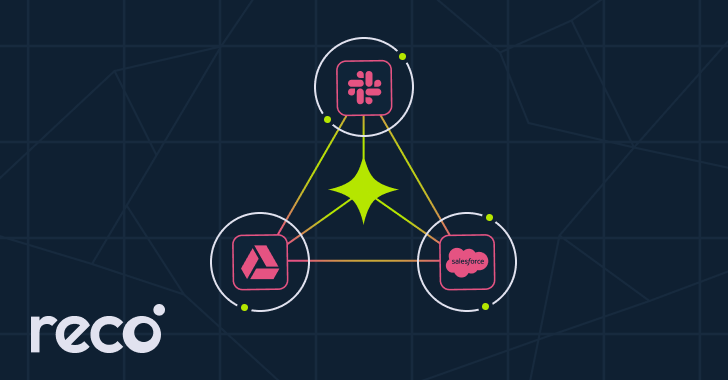
The same shape appears wherever an AI agent bridges Drive and Salesforce, a bot wires a source repository into a team channel, or any intermediary makes two apps trust each other through a grant that looks normal in each.
Why Single-App Reviews Miss Them
Conventional access review rarely catches this shape. It strains in the territory modern SaaS has opened up: non-human identities like service accounts, bots, and AI agents with no human behind them, trust relationships that form at runtime rather than at provisioning time, and OAuth and MCP bridges are wired between apps without the governance catalog knowing.
Answering “who holds this scope plus those two other scopes, and what can those scopes accomplish together” becomes much harder once the scopes in question live on a token nobody provisioned through any identity system to begin with.
The telemetry gap is widening quite fast.
AI agents, MCP servers, and third-party connectors now sit across two or three adjacent apps by default, and non-human identities outnumber human ones in most SaaS…
Source link
Disclaimer
We strive to uphold the highest ethical standards in all of our reporting and coverage. We blogs.grocliq.com want to be transparent with our readers about any potential conflicts of interest that may arise in our work. It’s possible that some of the investors we feature may have connections to other businesses, including competitors or companies we write about. However, we want to assure our readers that this will not have any impact on the integrity or impartiality of our reporting. We are committed to delivering accurate, unbiased news and information to our audience, and we will continue to uphold our ethics and principles in all of our work. Thank you for your trust and support.
Website Upgradation is going on for any glitch kindly connect at [email protected]