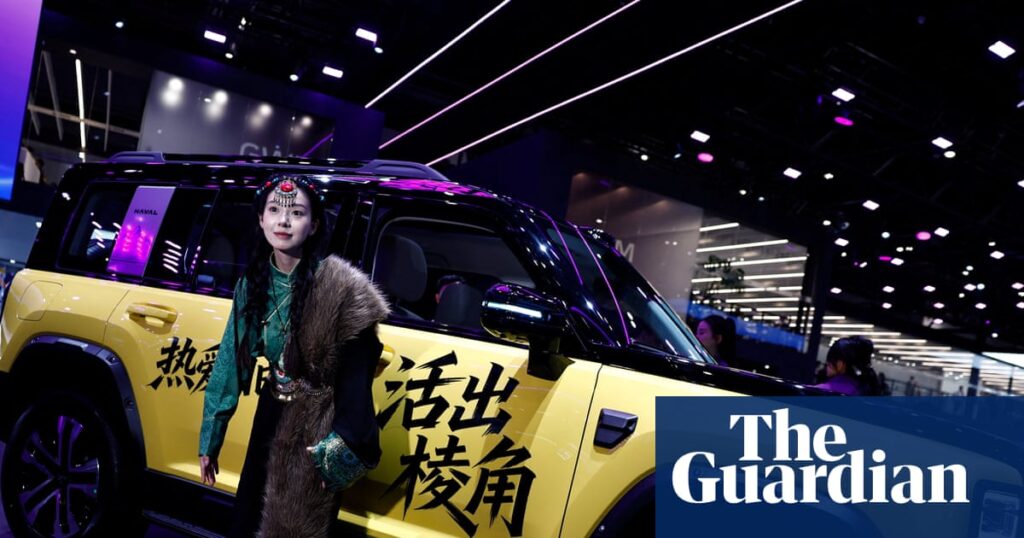

At the world’s biggest car fair, which opened in Beijing on Friday, there were hundreds of manufacturers, more than 1,000 vehicles, hundreds of thousands of enthusiasts – and hardly anyone behind a wheel.
China’s car companies have cornered the domestic electric vehicle market, and are increasingly visible on the global stage. Now they’re turning their attention to what they are betting is the future of mobility: autonomous driving.
At the Beijing Auto Fair, a huge industry event that covers 380,000 square metres on the outskirts of the capital, the country’s carmakers showed off a range of intelligent driving technologies.
In China’s cut-throat domestic market, nearly every big carmaker is investing heavily in the software and computing power needed to make “hands-free” driving a reality as they compete to offer additional perks and find new ways to generate revenue.
And Huawei, the telecommunications group, revealed this week that it would be investing up to 80bn yuan (£8.7bn) over the next five years to develop its autonomous driving software and computing power.
“The fact that almost every automaker has some version of intelligent driving makes it different to almost any market in the world,” said Tu Le, the managing director of Sino Auto Insights, a consultancy.
Le said that the Chinese market was so competitive that merely selling passenger vehicles domestically was no longer a viable way for Chinese companies to make money. Additional perks, such as leasing AI-powered software, are needed to boost revenues.
The EV maker Xpeng said its latest AI model allows drivers to give the car commands – such as, “park near the entrance to the shopping centre” – rather than a specific spot on a map.
An AI-powered operating system from Xiaomi, an appliance and phone maker, allows drivers to make restaurant reservations, compile notes while driving and place coffee orders. It can also detect when drivers seem stressed or agitated and adjust the lighting and music for their arrival at home.
Domestic car sales in China have fallen sharply in recent months. The number of passenger vehicles sold in China dropped by 17% in the first three months of this year as the government phased out a subsidy programme. BYD, the leader of China’s EV industry and the company seen as a bellwether for the sector, has reported seven consecutive months of declining sales.
China’s exports, meanwhile, soared by more than 60% in the first quarter.
China’s largest car exporter, Chery, has recently set its sights on the UK market. Since launching in the UK in August it has become on of the country’s fastest-growing car brands, with 13,500 cars sold between September and March.
On Friday, the company announced a goal for 10m global annual sales by 2030, up from 5m in 2025. Farrell Hsu, the UK country director for Chery, said: “This exceptional growth underlines…
Source link
Disclaimer
We strive to uphold the highest ethical standards in all of our reporting and coverage. We blogs.grocliq.com want to be transparent with our readers about any potential conflicts of interest that may arise in our work. It’s possible that some of the investors we feature may have connections to other businesses, including competitors or companies we write about. However, we want to assure our readers that this will not have any impact on the integrity or impartiality of our reporting. We are committed to delivering accurate, unbiased news and information to our audience, and we will continue to uphold our ethics and principles in all of our work. Thank you for your trust and support.
Website Upgradation is going on for any glitch kindly connect at [email protected]