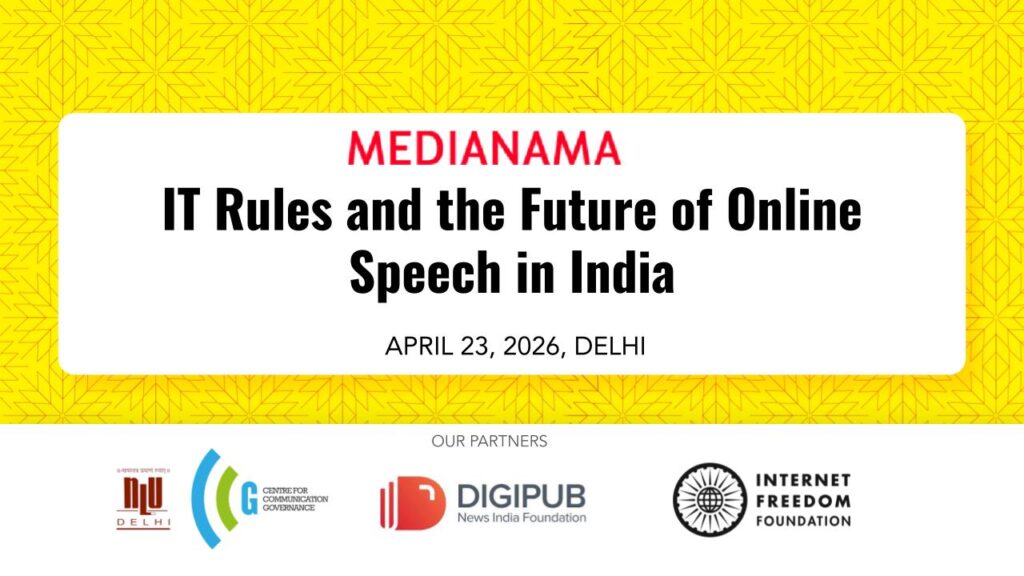

“Why three hours? Because campaign silence is 48 hours. If campaigning ends at 5:00 PM on a particular date, the campaign silence begins 48 hours before that, as per Section 126 of the Representation of the People Act. And it could be considered somewhat proportionate,” Snehashish Ghosh, founder of TechNiti and former public policy manager at Meta, said at MediaNama’s discussion on IT Rules and the Future of Online Speech in India, held in Delhi on 23 April. He also said that “it either has the sign of a political party or the photographs of a political leader or any other reference to the political party. It’s quite easy for a platform to make that decision.”
Background: He recalled the 2019 Voluntary Code of Ethics introduced and drafted by the industry body Internet and Mobile Association of India (IAMAI), which was later approved by the Election Commission of India (ECI) and said to treat them as “a decision/direction of the ECI” in the context of recent February 2026 amendments to the IT Rules, 2021, which introduced a similar three-hour content takedown approach. You can read the full code of ethics here [archived].
What must be checked within three hours: Rakesh Maheshwari, an ex-MeitY official who served as a designated official/designated officer for Section 69A at the Cyber Laws Division at the Ministry of Electronics and Information Technology (MeitY), laid out what the officials should accomplish in the three-hour window. He said, “So three hours basically means that you have to look at the following:
- completeness of the notice,
- competency of the person who is actually issuing it, the authorisation of this person, and
- sections of the law which are being quoted. Is the person actually authorised under that law? Or maybe you are dealing with some other law, but pointing to unlawfulness under a different statute.”
“If you [designated official] are satisfied on these three things, the government’s expectation is that you need not look further into the content, because that is where a responsible officer of the government has already done that due diligence,” he said.
Authorities need to submit the evidence too, not just URLs: “The fourth thing I also wanted to convey is that the notice must be accompanied by evidence as to why the content is considered unlawful. Simply sharing a URL and asserting that it is unlawful is not good enough. What is really required is an SOP that sets out the elements of what makes a notice complete and comprehensive enough to be acted upon,” Maheshwari further added during the discussion.
Why leaving the judgement to platforms is problematic: “It is not simply about whether the notice is valid, which is what Maheshwari Sir was talking about: signatures and authorisations. For instance, if a notice claims that a post is defamatory, should the intermediary be sitting in judgement to decide whether it is defamation or not? Because what you are…
Source link
Disclaimer
We strive to uphold the highest ethical standards in all of our reporting and coverage. We blogs.grocliq.com want to be transparent with our readers about any potential conflicts of interest that may arise in our work. It’s possible that some of the investors we feature may have connections to other businesses, including competitors or companies we write about. However, we want to assure our readers that this will not have any impact on the integrity or impartiality of our reporting. We are committed to delivering accurate, unbiased news and information to our audience, and we will continue to uphold our ethics and principles in all of our work. Thank you for your trust and support.
Website Upgradation is going on for any glitch kindly connect at [email protected]