
The thing about unfilmable works of literature is that most of them eventually turn out to be quite filmable after all. The Lord of the Rings was a bit of a mess when shot in rotoscope on a minuscule budget by the guy who filmed Fritz the Cat; it won Oscars when handed to Peter Jackson, given the GDP of a small nation and a visual effects department the size of Gondor. The 1984 version of Dune was a disappointment, despite the presence of David Lynch in the director’s chair, largely because all that gleaming, tawdry galactic opulence couldn’t make up for the comprehensively bad acting, clotted exposition and obsession with freaky heart plugs. And yet the 2021 adaptation from Denis Villeneuve ended up being a tour de force of masterly restraint and monolithic scale.
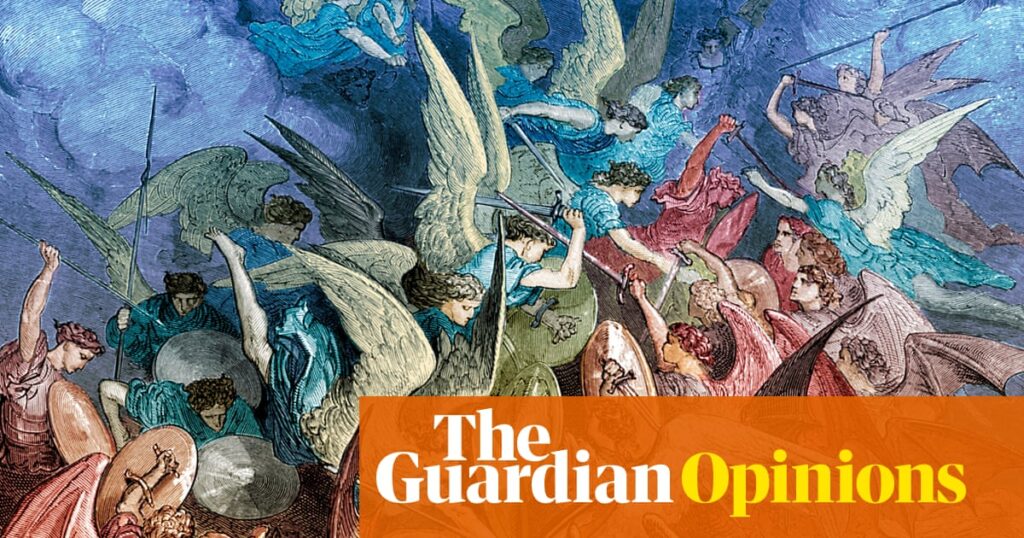
Milton’s Paradise Lost? The 17th-century epic poem has always felt like an outlier, a work of literature too religiously inspired to be filmed purely as a work of fantasy, yet too riotously bonkers to be treated with puritanical reverence. It contains more drama than the entire Marvel Cinematic Universe in every line of thunderous God-baiting iambic pentameter. And now Roger Avary, co-writer of Pulp Fiction and director of Killing Zoe and The Rules of Attraction, wants to bring it to the big screen using the power of AI.
It’s a strange time, possibly a politically injudicious time, to be announcing that you’re about to hand over the most epic story ever written (about the fall of Satan from heaven and humankind’s original sin) to this particular technology.
Away from discussions about livelihoods and the small matter of authorship, there remains the question of whether this new technology is really capable of creating anything but the most ersatz of artistic forms, the phenomenon widely known as “AI slop”. Three years ago, Avengers director Joe Russo predicted that we would soon be watching movies that were entirely created via artificial intelligence And yet, so far even the most impressive – and they have not been all that impressive – examples of AI film-making have relied on actual people to curate usable shots and coherent edits.
Perhaps there really will come a day where we can walk into our front room and switch on a bespoke AI Netflix movie, starring a slightly better-looking version of you or I solving problems neither of us have ever had, in which every line lands, all arcs resolve and nothing ever risks surprising anyone, ever. But we are not there yet. Maybe Avary will be able to use AI angels in the architecture to deliver the kind of cosmic spectacle that once required armies of actual people, at a fraction of the price. Possibly he’ll even make it look like cinema.
Yet, here’s the thing. Paradise Lost is too great, too…
Source link
Disclaimer
We strive to uphold the highest ethical standards in all of our reporting and coverage. We blogs.grocliq.com want to be transparent with our readers about any potential conflicts of interest that may arise in our work. It’s possible that some of the investors we feature may have connections to other businesses, including competitors or companies we write about. However, we want to assure our readers that this will not have any impact on the integrity or impartiality of our reporting. We are committed to delivering accurate, unbiased news and information to our audience, and we will continue to uphold our ethics and principles in all of our work. Thank you for your trust and support.
Website Upgradation is going on for any glitch kindly connect at [email protected]