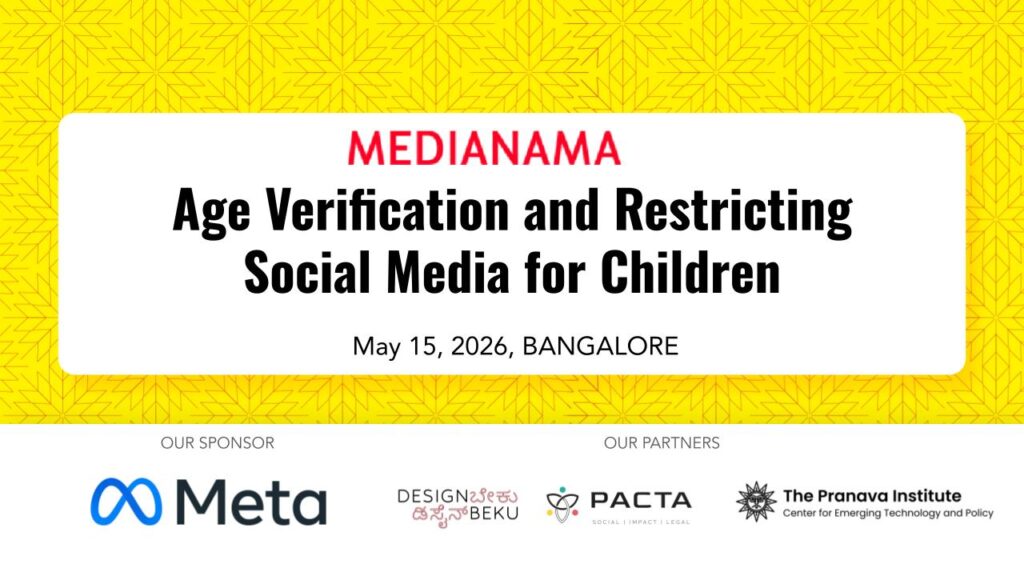

Note: The discussion was held under the Chatham House Rule. All quotes have been edited for clarity, brevity and anonymity.
“We immunize children against Polio, right? If we immunize an entire population irrespective of privilege and access. What stops us from also bringing that level of agency to children?” asked a female parent during the roundtable discussion on Age Verification and Restricting Social Media for Children on May 15 in Bengaluru.
Build Child’s resilience against internet & platform harms: “We need to look at immunizing children and building resilience in the child against the harms, because the harms are not going away,” said a female parent speaker.
She made this point after saying that, as a parent, she would be uncomfortable sharing a child’s facial data for age verification with the Big tech, regardless of her allegiances. She cited DigiYatra as an example of trading privacy for convenience.
When the female speaker pointed out that the privilege of child agency is hard-earned, Nikhil Pahwa, MediaNama’s editor and moderator of the discussion, countered: What about those who don’t have that privilege?
“That doesn’t mean they will never have it. So you need to build that agency for them so that, at some point in time, they can access it,” said the speaker.
Countering this another speaker who works with schools as a teacher said:
Underpreviliged children with minimal agency can’t be exposed to everything online: “Sorry, I don’t agree with that point. We cannot say that unprivileged kids should simply be exposed to everything. It’s similar to saying, ‘I can bully you so that you become immunized against bullying.’ It doesn’t work like that.”
She pointed out that the way the children’s brain develops is “very nuanced and sensitive” and emphasized the impact such misguided, agency-led exposure to internet content, including social media and games, can have on children’s development and mental health.
UK considered child’s agency while drafting age appropriate design code: During the discussion Nikhil Pahwa recalled Sonia Livingstone, Professor of social psychology at The London School of Economics and Political Science, who was involved in drafting the UK’s age-appropriate design code and said “they created the regulation with the child’s agency in mind first.”
During the roundtable discussion, several speakers suggested various interventions that could help reduce online harm to children. Some focused on what parents can, or should, do, while others focused on the role schools can play in reducing online harms and building a child’s agency.
Why parent-first digital literacy to strengthen children’s agency could be effective? “Regulatory effectiveness has to take a multi-modal approach of even fixing accountability and responsibility,” said a speaker. He asked the following questions that could indicate where the right…
Source link
Disclaimer
We strive to uphold the highest ethical standards in all of our reporting and coverage. We blogs.grocliq.com want to be transparent with our readers about any potential conflicts of interest that may arise in our work. It’s possible that some of the investors we feature may have connections to other businesses, including competitors or companies we write about. However, we want to assure our readers that this will not have any impact on the integrity or impartiality of our reporting. We are committed to delivering accurate, unbiased news and information to our audience, and we will continue to uphold our ethics and principles in all of our work. Thank you for your trust and support.
Website Upgradation is going on for any glitch kindly connect at [email protected]