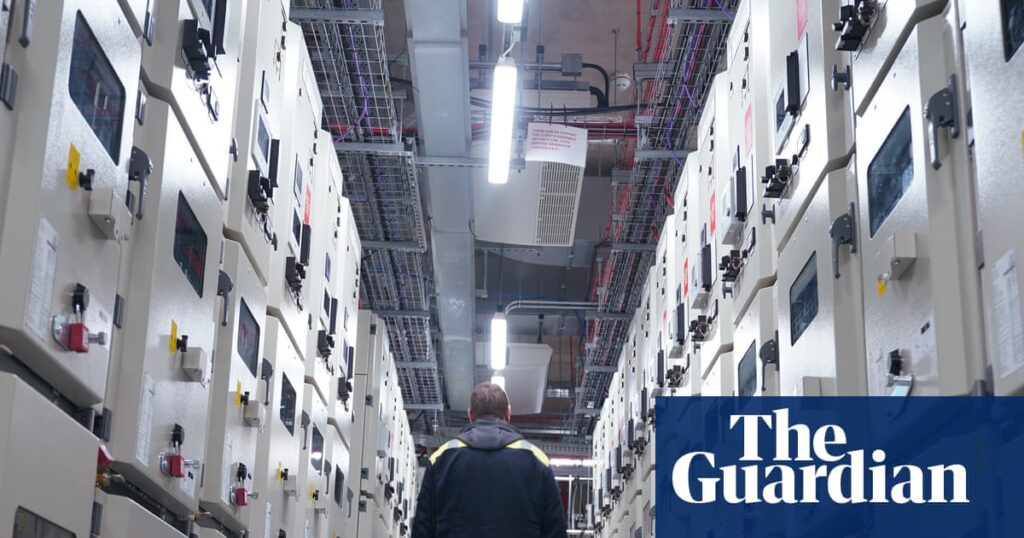

A Scottish government policy designed to encourage datacentres to build in Scotland could lead to a massive volume of carbon emissions being ignored, according to an analysis by a Scottish charity.
“Green datacentres” are at the heart of Scotland’s ambitions to develop economically. Enshrined in national policy, they are part of a larger, UK-wide effort to attract big AI investment to Scotland.
But Scotland appears to have no clear definition of what a “green datacentre” is. This means that current AI developments might call themselves “green” while their impact on the climate are ignored, according to Action to Protect Rural Scotland (APRS), an Edinburgh-based charity.
The Green MSP Ariane Burgess, representing Highlands and Islands, said: “We urgently need transparency around what constitutes a ‘green datacentre’ and how their huge energy demands will be accommodated by our grid infrastructure.
“So far, the answers we’ve been getting out of the Scottish government have not provided any clarity,” she said.
More than a dozen datacentres in Scotland are in the process of getting planning permission, including an AI growth zone in Lanarkshire, near Glasgow, which claims to be backed by £8.2bn in private investment.
Collectively, they stand to use roughly 6.2GW of power – one-and-a-half times more than the peak power use of all of Scotland in the winter.
In April, Fintan Slye, the chief executive of the UK’s National Energy System Operator (Neso), encouraged datacentre developers to build in Scotland, where they could take advantage of its greater proportion of renewable energy, with fewer grid constraints. “If in the audience you have a big datacentre and you want to go to Scotland, please come talk to me, we will help you,” Slye said to a conference in London, reported by the Financial Times.
APRS said that calling a datacentre project “green” and presenting it as aligned with Scotland’s goals, even if it had significant emissions, could allow developers to receive favourable treatment from local authorities.
A datacentre in Edinburgh this year appeared to have argued it was a “green datacentre” in submissions to local authorities, despite the fact it will include 200 diesel backup generators – the equivalent of 100,000 idling cars, according to APRS.
A planning committee appeared to have accepted this definition, albeit while conceding there was no definition of “green datacentres” in Scotland’s underlying policy, the National Planning Framework 4 (NPF4).
The framework mentions “green datacentres” as part of a larger national priority and says these will have an “overall negligible impact on achieving greenhouse gas emission reduction targets”.
APRS found the underlying analysis used by NPF4 to reach this conclusion appeared to have been done in 2022, before the release of ChatGPT, and has not been updated since. At that time, analysts concluded that any increase in emissions caused by…
Source link
Disclaimer
We strive to uphold the highest ethical standards in all of our reporting and coverage. We blogs.grocliq.com want to be transparent with our readers about any potential conflicts of interest that may arise in our work. It’s possible that some of the investors we feature may have connections to other businesses, including competitors or companies we write about. However, we want to assure our readers that this will not have any impact on the integrity or impartiality of our reporting. We are committed to delivering accurate, unbiased news and information to our audience, and we will continue to uphold our ethics and principles in all of our work. Thank you for your trust and support.
Website Upgradation is going on for any glitch kindly connect at [email protected]