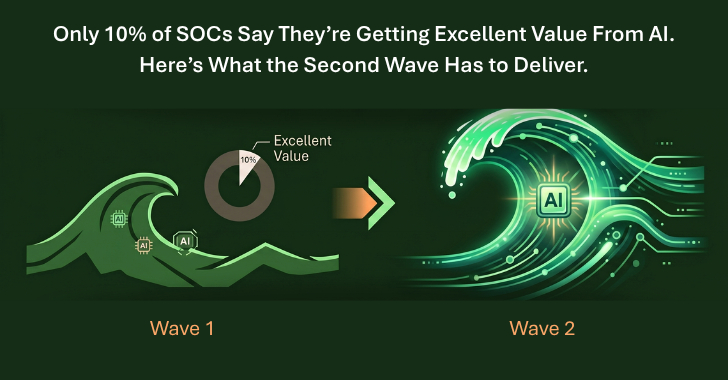


Eighteen months ago, the AI SOC was a marketing line. Today it’s a budget item. The category has crossed over from interesting to inevitable, with billions of dollars now flowing into AI-powered security operations platforms, agentic SOC tools, and AI co-pilots built into every layer of the security stack. The data shows SOCs are buying, deploying, and standing up AI capabilities at the fastest pace the industry has ever seen.
And yet, the same SOCs reporting record AI adoption are reporting underwhelming outcomes. The first objective benchmark on the value of AI in the SOC was published in the SOC-CMM 2026 Maturity Report in May, drawing on survey data collected from roughly 200 SOCs across regions, sectors, and delivery models between late January and mid-March 2026. Only about 10% of respondents said AI has delivered excellent value to their SOC. About 19% reported good value. The remaining 71% landed at some value or none at all.
Eighteen months into AI deployment, that’s a structural signal. What follows is a read on what the data confirms, and on what the next wave of AI in security operations must deliver if the industry is going to close the gap.
What the SOC-CMM 2026 data shows
Three findings stand out in the SOC-CMM report’s AI section, and they correlate cleanly with each other once they are read together.
First, adoption is up across every category of AI used inside the SOC. Off-the-shelf large language models grew 55% year over year. AI co-pilots grew 145%. AI agents grew 118%. Supervised machine learning grew 96%. Customized LLMs grew 64%. SOC teams are over-investing in AI without the operational maturity to extract value from what they bought.
Second, the dominant adoption pattern is what the report calls the taker model: off-the-shelf AI deployed inside an existing security stack without customization. About 65% of SOCs surveyed describe themselves as takers. Another 20% are shapers, customizing what they buy. Only 15% are builders, training models against their own data. The takers are the largest cohort and the cohort reporting the least value. Across hybrid SOCs, in-house SOCs, and MSSP SOCs, the perceived value distribution is nearly identical. That uniformity is the tell. The pattern cuts across delivery model, region, and sector. The cause is structural.
Third, the report flags that the two SOC improvement challenges that grew year over year are lack of best practices (+17%) and complexity of increasing maturity (+11%). Every other challenge category, including lack of budget and lack of management support, dropped. SOCs aren’t telling the survey they don’t have money or executive support. They’re telling the survey they don’t know what they’re supposed to be doing with the AI they bought. That is the AI maturity gap in one data point.
Why the first wave of AI in the SOC underperformed
The first wave of AI SOC tools shipped as features bolted onto existing security products. SIEMs got AI triage. EDRs got AI…
Source link
Disclaimer
We strive to uphold the highest ethical standards in all of our reporting and coverage. We blogs.grocliq.com want to be transparent with our readers about any potential conflicts of interest that may arise in our work. It’s possible that some of the investors we feature may have connections to other businesses, including competitors or companies we write about. However, we want to assure our readers that this will not have any impact on the integrity or impartiality of our reporting. We are committed to delivering accurate, unbiased news and information to our audience, and we will continue to uphold our ethics and principles in all of our work. Thank you for your trust and support.
Website Upgradation is going on for any glitch kindly connect at [email protected]