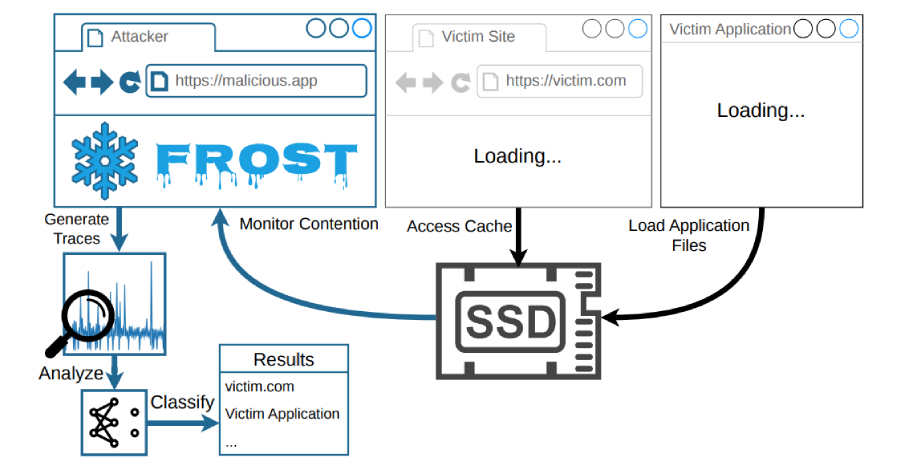


A malicious website can work out which sites you visit and which apps you open, using nothing but JavaScript and the timing of your SSD. The attack, called FROST, needs no native code, no extension, and no permission prompt.
You open the page, leave the tab sitting there, and it watches the drive for contention in the background.
Researchers at Graz University of Technology built it and described it in a new paper set to appear at DIMVA 2026. It abuses a storage feature present in every major desktop browser, and the underlying timing channel works on both macOS and Linux.
SSD timing attacks are not new. Last year the same group published Secret Spilling Drive, which read user behavior off a drive by watching how reads slow down when something else is using it. The catch was that it needed native code on the machine, through a low-level interface like Linux’s io_uring. FROST drops that requirement. It runs inside the browser sandbox, which turns a local attack into a remote one.
You no longer have to be on the machine to pull it off.
The same Graz lab has done this before. Its SnailLoad attack inferred the sites and videos a victim loaded from network latency alone, no JavaScript at all.
How FROST Attack Works
The way in is the Origin Private File System, or OPFS, a storage feature browsers added in 2023 so web apps like in-browser editors and IDEs can keep files on disk. OPFS gives each origin its own sandboxed slice of the file system, and because that slice is walled off, it skips the permission prompt a page normally needs to reach your files. No dialog, no click. A site can just start writing.
Normally the operating system hides disk timing behind the page cache, serving repeated reads from memory so they never touch the drive.
FROST gets around this by creating a file larger than the machine’s RAM. The cache cannot hold all of it, so reads keep landing on the SSD. On Chrome and Safari, OPFS can grow to 60% of disk space, far more than enough; Firefox caps each origin lower, though an attacker can spread the load across multiple origins to get past that.

The attacker’s code then reads random 4 kB chunks of that file in a loop, and times each read with performance.now(). Browsers blunt their timers by default to make this kind of measurement harder, but the attacker sharpens the resolution back up by switching on cross-origin isolation, which it can do freely on its own page.
When you open a site or launch an app on the same drive, that activity competes with the attacker’s reads, and the timing shifts measurably. A neural network trained on those traces identifies the site or app.
The accuracy is the uncomfortable part. On a Mac, against the top 50 websites, FROST identified the site being visited with an F1 score of 88.95% in a closed-world test, and held at 86.95% in an open-world test that added 300 sites it had never seen. For ten native, pre-installed macOS apps, it reached 95.83%. The team also built a covert channel…
Source link
Disclaimer
We strive to uphold the highest ethical standards in all of our reporting and coverage. We blogs.grocliq.com want to be transparent with our readers about any potential conflicts of interest that may arise in our work. It’s possible that some of the investors we feature may have connections to other businesses, including competitors or companies we write about. However, we want to assure our readers that this will not have any impact on the integrity or impartiality of our reporting. We are committed to delivering accurate, unbiased news and information to our audience, and we will continue to uphold our ethics and principles in all of our work. Thank you for your trust and support.
Website Upgradation is going on for any glitch kindly connect at [email protected]