

Security teams have never had more IP data at their disposal. Every day, analysts ingest enrichment feeds, geolocation data, reputation scores, telemetry, and threat intelligence from a growing ecosystem of vendors and platforms.
Yet despite this abundance of information, many organizations continue to face a fundamental challenge: sifting through the noise to understand who is behind an IP and what action should follow.
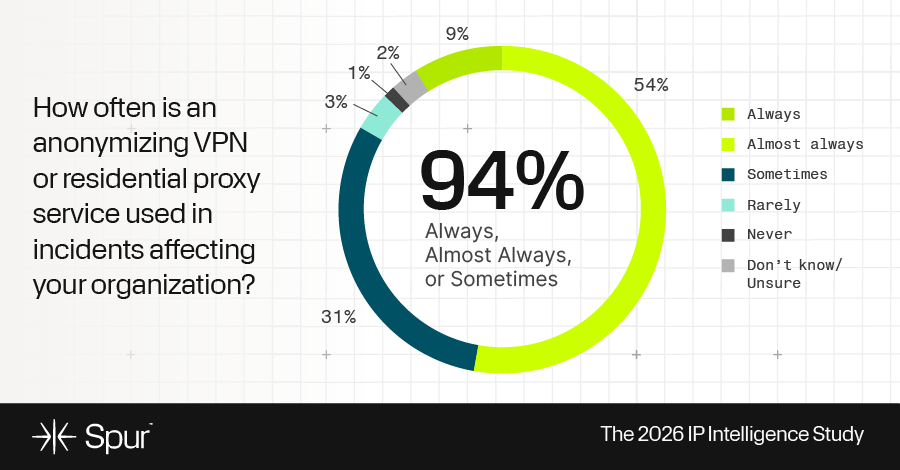
Case in point: a recent industry study of more than 200 security practitioners conducted by Spur Intelligence found that anonymizing infrastructure – including VPNs and residential proxy networks – now appears in nearly every security incident.
At the same time, the study showed that many organizations admit they lack the visibility, context, and operational workflows needed to make effective decisions based on that IP data.

The findings support a broader industry trend: a reactive approach to managing IP-based risks.
The Rise of Anonymized Infrastructure
The widespread availability of VPN services, residential proxy networks, and other anonymization tools has fundamentally changed how cybercriminals operate. Residential proxies route traffic through consumer internet connections, making malicious activity blend in with normal user behavior. VPN services provide additional layers of anonymity while allowing rapid switching between locations and network identities. As a result, traditional approaches based solely on reputation or static blocklists are becoming less effective.
Security teams are increasingly encountering attacks where the IP address itself provides little immediate insight into intent.

The Spur study showed that nearly half of companies reported significant operational or financial impact from account takeover attempts and credential abuse via VPNs and residential proxies. In these incidents, an address may appear residential, belong to a legitimate ISP, and exhibit no prior malicious reputation while still being part of an active attack campaign.
The Context Deficit
One of the most significant obstacles facing security operations today is a lack of contextual information to help determine who is actually behind a connection.

The Spur study reinforces this observation, with nearly half of respondents saying a lack of context is the biggest challenge for their security teams analyzing IP activity.
Basic IP attributes, such as geolocation and network ownership, remain useful, but they often fail to explain the intent behind activity.
Security teams increasingly need additional layers of context, including infrastructure classification, VPN and proxy attribution, behavioral indicators, historical usage patterns, device and session correlations, and automation and bot signals.
Without this context, analysts are forced to make decisions based on incomplete information. With context, they can understand not only where traffic is coming from, but also why it may represent elevated risk.
Reactive…
Source link
Disclaimer
We strive to uphold the highest ethical standards in all of our reporting and coverage. We blogs.grocliq.com want to be transparent with our readers about any potential conflicts of interest that may arise in our work. It’s possible that some of the investors we feature may have connections to other businesses, including competitors or companies we write about. However, we want to assure our readers that this will not have any impact on the integrity or impartiality of our reporting. We are committed to delivering accurate, unbiased news and information to our audience, and we will continue to uphold our ethics and principles in all of our work. Thank you for your trust and support.
Website Upgradation is going on for any glitch kindly connect at [email protected]