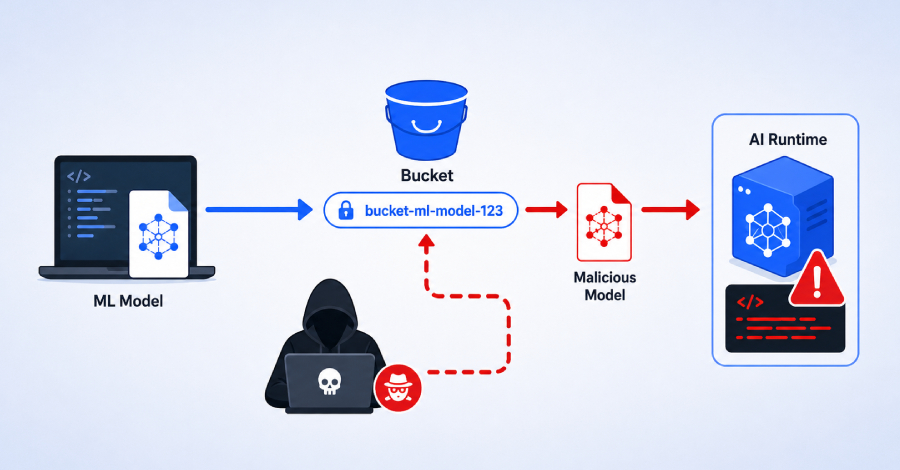


A flaw in the Google Cloud Vertex AI SDK for Python let an attacker with no access to a victim’s project hijack the victim’s machine learning model upload and run code inside Google’s serving infrastructure.
Palo Alto Networks Unit 42, which found and reported the bug through Google’s bug bounty program, calls the technique “Pickle in the Middle” and said it saw no exploitation in the wild. Google has patched it; if you use the SDK, update to version 1.148.0 or later.
The attacker needed only a Google Cloud project of their own and the victim’s project ID, which is often public. No credentials, no phishing, no foothold in the target.
The flaw was in how the SDK chose a temporary Cloud Storage bucket for model uploads. If a user did not set a bucket, the SDK generated a predictable name from the project ID and region, such as project-vertex-staging-region. It checked whether that bucket existed, but not whether the victim owned it.
Because bucket names are globally unique, an attacker could create the expected bucket first in their own project. The victim’s SDK would then upload the model files to the attacker’s bucket. The attacker could then replace the uploaded model with a malicious one.
Many Python ML models are saved with pickle or joblib, which can run code when a file is loaded. When Vertex AI later loaded the swapped model, the attacker’s code executed inside the serving container.
The attack depended on speed. Unit 42 measured about 2.5 seconds between the victim’s upload and Vertex AI reading the file. In its proof of concept, the attacker used a Cloud Function that triggered after upload and replaced the model in 1.4 seconds, before Vertex AI read it.
The payload then stole an OAuth token from the serving container’s metadata server and sent it to the attacker. In Unit 42’s test environment, that token was not limited to the compromised deployment. It could access other model artifacts in the same Google-managed tenant project, including a full TensorFlow model with trained weights, as well as BigQuery metadata, access lists, tenant logs, GKE cluster names, and internal container image paths.

The attack worked only under specific conditions: the victim’s default staging bucket did not already exist in that region, and the victim left the staging_bucket parameter unset. The first is common for a new project in Vertex AI in a region.
The second depends on the developer relying on the SDK’s default rather than naming their own bucket.
Unit 42 reported the flaw through Google’s Vulnerability Reward Program on March 5, 2026. It tested versions 1.139.0 and 1.140.0, the latest available at the time, and found both vulnerable.
Google shipped an initial fix in v1.144.0 on March 31, adding a random uuid4 to the bucket name. It completed the fix in v1.148.0 on April 15, adding bucket ownership verification to block bucket squatting in Model.upload()….
Source link
Disclaimer
We strive to uphold the highest ethical standards in all of our reporting and coverage. We blogs.grocliq.com want to be transparent with our readers about any potential conflicts of interest that may arise in our work. It’s possible that some of the investors we feature may have connections to other businesses, including competitors or companies we write about. However, we want to assure our readers that this will not have any impact on the integrity or impartiality of our reporting. We are committed to delivering accurate, unbiased news and information to our audience, and we will continue to uphold our ethics and principles in all of our work. Thank you for your trust and support.
Website Upgradation is going on for any glitch kindly connect at [email protected]