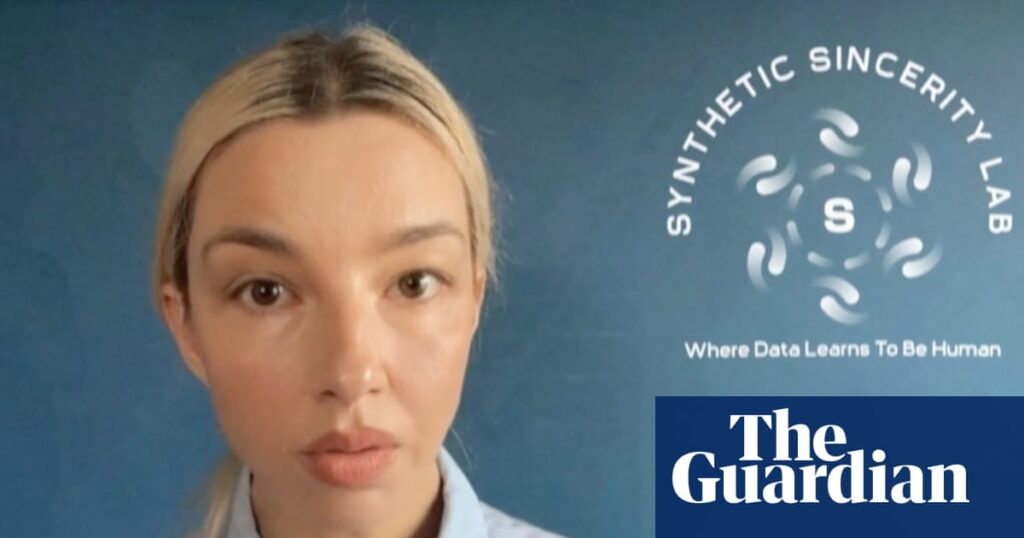

In Marc Isaacs’ latest film, the subversive documentary maker reveals that an AI research laboratory recently licensed his entire body of work. That’s a quarter-century of droll, deadpan studies of ordinary life in Britain – from the poetic Lift, about the comings and goings in a London tower block, and The Curious World of Frinton-on-Sea, set in the sleepy retirement town dubbed “God’s waiting room”, to Philip and His Seven Wives, in which a secondhand furniture dealer declares himself to be a Hebrew king. Isaacs agreed to let data analysts at the University of Southern England feed these and other documentaries into their system to harvest authentic human emotions from which AI characters could then be created. His film about the experience takes its name from the university’s lab: Synthetic Sincerity.
But how synthetic is the film itself? “Well, we made up the University of Southern England,” admits Isaacs, 59, over lunch at Etles, a Uyghur restaurant near his home in London. The choice of venue is no accident: its chef and owner, Ablikim Rahman, who flutters around us today bearing bowls of thick, glossy leghmen noodles, appears in Synthetic Sincerity being photographed by the AI boffins and turned into an avatar. This is Rahman’s first film, though he hasn’t seen it yet: “Soon,” he says with a sheepish smile.
Sitting across from Isaacs is the film’s 67-year-old writer, Adam Ganz. “Making it a fictitious university meant we didn’t need anyone’s permission,” Ganz explains. So has Isaacs genuinely been approached to license his work for AI? “No,” the director says with a shrug, “but I’ve heard about people who have.”
He and Ganz aren’t trying to pull a fast one with Synthetic Sincerity. Rather, they use its artificiality to wriggle into places that more straightforward documentaries can’t reach. These wilful fabrications began with their two previous pictures. The Filmmaker’s House, confined largely to Isaacs’ home as he is inundated by visitors over the course of one day, and This Blessed Plot, about a Chinese student shooting a film in a pretty rural corner of Essex, each departed radically from documentary convention. This Blessed Plot stars several figures who appeared as themselves in Isaacs’ earlier work but are recast in the newer film as fictional characters; one even plays a ghost.
Though the three pictures have the appearance of documentaries, they all feature non-actors performing scenarios and dialogue written by Isaacs and Ganz. In Iran, the technique has proliferated, producing masterpieces such as Abbas Kiarostami’s Close-Up, which Sight and Sound magazine named as one of the 20 greatest films of all time. In the UK, the staged or scripted reality genre is more readily associated with TV mainstays such as Made in Chelsea and The Only Way Is Essex, though it has also resulted in homegrown cinematic gems: Michael Winterbottom’s 2002 refugee drama…
Source link
Disclaimer
We strive to uphold the highest ethical standards in all of our reporting and coverage. We blogs.grocliq.com want to be transparent with our readers about any potential conflicts of interest that may arise in our work. It’s possible that some of the investors we feature may have connections to other businesses, including competitors or companies we write about. However, we want to assure our readers that this will not have any impact on the integrity or impartiality of our reporting. We are committed to delivering accurate, unbiased news and information to our audience, and we will continue to uphold our ethics and principles in all of our work. Thank you for your trust and support.
Website Upgradation is going on for any glitch kindly connect at [email protected]