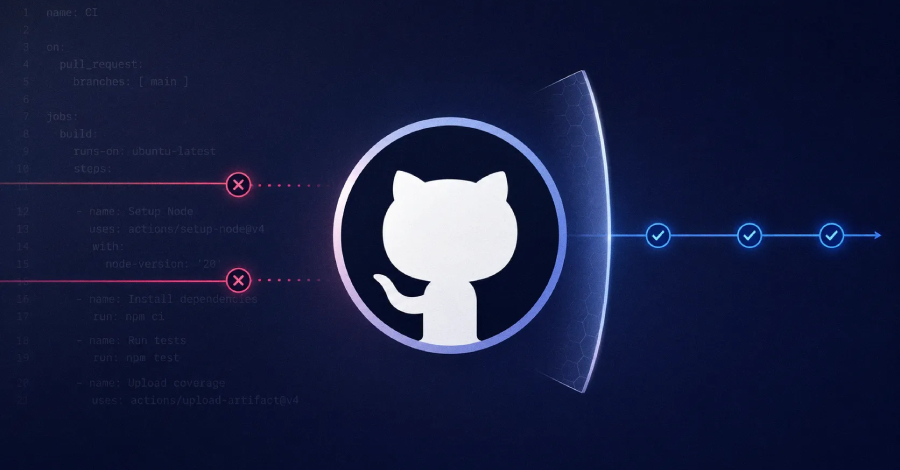


GitHub is moving to strengthen software supply chain security by updating “actions/checkout” to block pwn request attacks that exploit the risky use of the “pull_request_target workflow” trigger to run malicious code with the workflow’s full privileges.
Effective June 18, 2026, the latest version of “actions/checkout,” the official GitHub action for checking out a repository into the workflow’s runner, refuses common pwn request patterns by default. The change is expected to be backported to all currently supported major versions on July 16, 2026.
“Actions/checkout v7 refuses to fetch fork pull request code in pull_request_target and workflow_run workflows (the latter only when workflow_run.event is a pull_request* event),” it added.
The refusal occurs when the pull request is from a fork, and any of the following criteria is met, unless workflow authors explicitly opt out of it by setting the “allow-unsafe-pr-checkout” flag to “true” in “actions/checkout” –
- repository: resolves to the fork pull request’ repository
- ref: matches refs/pull/number/head or refs/pull/number/merge
- ref: resolves to a fork pull request’s head or merge commit SHA
The change is aimed at preventing the most common form of pwn requests in the Actions ecosystem. As a result, “actions/checkout” will fail for “pull_request_target events” from forks with insecure inputs.
“Pull_request_target” is a workflow trigger that’s automatically run without requiring manual approval when a pull request is opened or reopened, or when the head branch of the pull request is updated. It’s important to note that the event runs in the context of the default branch of the base repository, potentially exposing secrets and a privileged GITHUB_TOKEN with both read and write permissions.
“Running untrusted code on the pull_request_target trigger may lead to security vulnerabilities,” GitHub notes in its documentation. “These vulnerabilities include cache poisoning and granting unintended access to write privileges or secrets.”
The danger arises when a “pull_request_target” is combined with “actions/checkout” to download and execute code submitted by an untrusted fork. Should a bad actor submit a pull request containing malicious scripts and the workflow checks out and runs the code, it can allow the attacker to steal the GITHUB_TOKEN and other secrets, leading to what’s called a pwn request attack.
“Workflows triggered by pull_request_target run with the base repository’s GITHUB_TOKEN, secrets, and default-branch cache access,” GitHub said. “Checking out the head of an unreviewed pull request from a fork inside one of these workflows typically lets attacker-controlled code execute with the workflow’s full privileges.”
In recent months, a number of software chain attacks have weaponized this behavior. The most severe of them was the compromise of multiple packages associated with the Nx build system as…
Source link
Disclaimer
We strive to uphold the highest ethical standards in all of our reporting and coverage. We blogs.grocliq.com want to be transparent with our readers about any potential conflicts of interest that may arise in our work. It’s possible that some of the investors we feature may have connections to other businesses, including competitors or companies we write about. However, we want to assure our readers that this will not have any impact on the integrity or impartiality of our reporting. We are committed to delivering accurate, unbiased news and information to our audience, and we will continue to uphold our ethics and principles in all of our work. Thank you for your trust and support.
Website Upgradation is going on for any glitch kindly connect at [email protected]