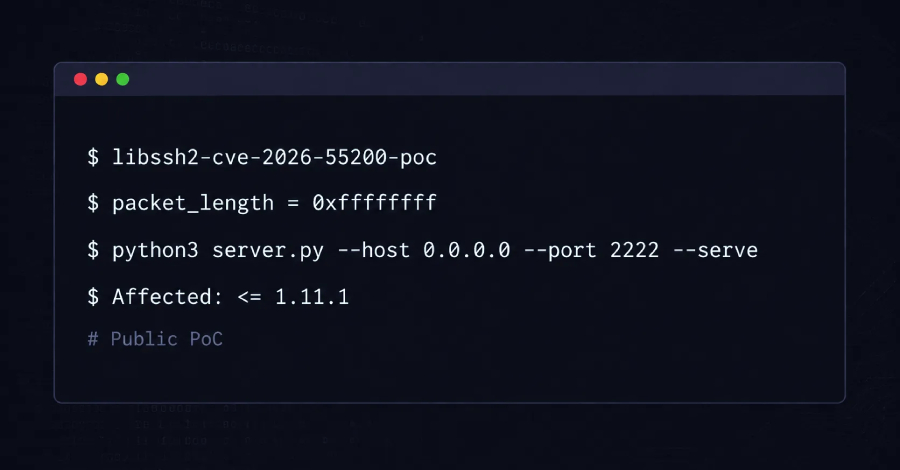


A public proof-of-concept is now out for CVE-2026-55200, a critical flaw in libssh2 that lets a malicious or compromised SSH server trigger memory corruption on a connecting client, with possible code execution. No credentials, no user interaction. The bug affects every release up to and including 1.11.1 and carries a CVSS 4.0 score of 9.2.
libssh2 is a client-side SSH library, not a server. That distinction matters. It is embedded in curl, Git, PHP, backup agents, firmware updaters, and a long tail of appliances.
Anything that links it and reaches out to an untrusted SSH endpoint is a potential target. Many of those copies are statically linked, so a distro package update will not touch them, and you may not know they are there.
How the bug works
The flaw lives in ssh2_transport_read() in transport.c, the function that parses incoming SSH packets during the handshake. It read the attacker-controlled packet_length field and rejected only values below 1. It never enforced an upper bound.
The size calculation adds packet_length to a couple of small values using 32-bit arithmetic, so a length of 0xffffffff wraps around to a tiny number. libssh2 then allocates a buffer sized for the tiny number, while later code writes the full, oversized packet into it.
The result is an out-of-bounds heap write, classed as CWE-680, integer overflow to buffer overflow, a classic primitive for code execution. The fix adds the missing check, rejecting any packet_length above LIBSSH2_PACKET_MAXPAYLOAD before the math runs.
libssh2 has tripped over this before. In 2019, it shipped version 1.8.1 to fix a batch of nine flaws led by CVE-2019-3855, a near-identical integer overflow in its transport read that also let a malicious server run code on a connecting client. Seven years later, the same class of bug is back in the same code.
Security researcher Tristan Madani reported the issue. Maintainers merged the patch through pull request #2052 on June 12. VulnCheck published the CVE on June 17.
A public proof-of-concept has been published in “exploitarium,” a GitHub archive of exploit code whose author says entries were posted without prior reporting. The archive contains a locally verified SSH trigger scaffold and a controlled local RCE harness for the libssh2 bug, not a turnkey remote exploit. Reliable code execution against a live application would still depend on the target binary, allocator behavior, mitigations, and how the software embeds libssh2.
The context is worth weighing. The author concedes the archive went out incomplete, with some entries weak and AI driving the fuzzing. As of now, CISA’s exploitation rating for the CVE still reads none, and no in-the-wild use has been reported.
What to do
There is no fixed libssh2 release yet. The patch sits in the mainline source, and a tagged release is still being prepared, so Linux distributions and downstream projects are…
Source link
Disclaimer
We strive to uphold the highest ethical standards in all of our reporting and coverage. We blogs.grocliq.com want to be transparent with our readers about any potential conflicts of interest that may arise in our work. It’s possible that some of the investors we feature may have connections to other businesses, including competitors or companies we write about. However, we want to assure our readers that this will not have any impact on the integrity or impartiality of our reporting. We are committed to delivering accurate, unbiased news and information to our audience, and we will continue to uphold our ethics and principles in all of our work. Thank you for your trust and support.
Website Upgradation is going on for any glitch kindly connect at [email protected]