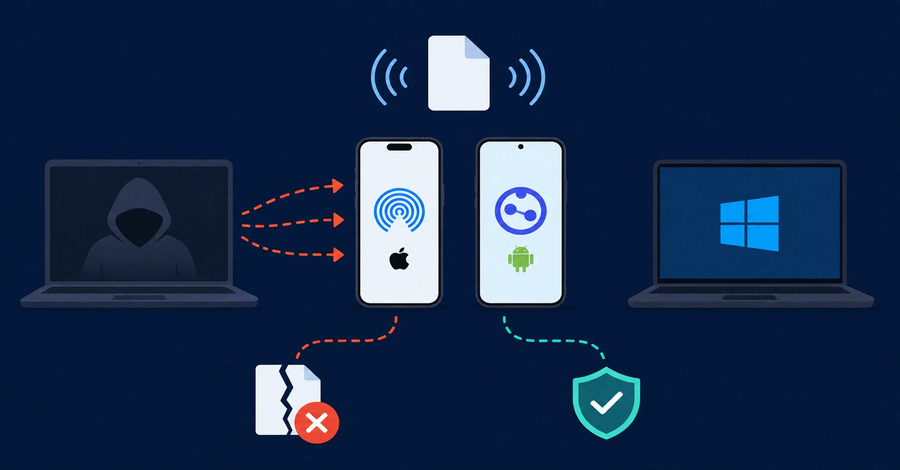


Two researchers have found six security flaws in AirDrop and Quick Share, the wireless features that beam files between nearby devices with no cables or shared network.
An attacker within wireless range, with just a laptop and no prior connection, can crash the sharing service on a Mac or iPhone set to receive from anyone, with no tap or prompt.
The same research found Quick Share flaws that bypass Samsung’s session checks and trigger a potentially exploitable crash in Google’s Windows app.
The two features run inside an ecosystem of more than five billion active Apple and Android devices, though the tested bugs hit specific implementations and versions.
The work, laid out in a new research paper by Arash Ale Ebrahim and Nils Ole Tippenhauer of the CISPA Helmholtz Center for Information Security, is the first to pull both stacks apart side by side, above the radio layer, where discovery becomes session handling, parsing, and trust decisions.
The fixes have already started. Apple has patched one of the three AirDrop bugs and assigned it a CVE, though the advisory is not yet public; the other two are still in coordinated disclosure. Google paid a bounty for the Windows flaw and has landed a code fix, with its CVE still pending.
Samsung’s two bugs were handed to Google and remain under investigation. No public reports of these flaws being exploited have surfaced as of this writing.
Three ways to knock out Apple’s sharing
All three AirDrop flaws end in the same crash: they take down sharingd, the background service on macOS and iOS that handles AirDrop. The catch is that this service also runs AirPlay, Handoff, Universal Clipboard, Continuity Camera, and NameDrop, so one crash takes the whole set down together.
The simplest of the three needs only a single malformed request sent to a device with AirDrop set to receive from “Everyone.” Send those crash messages on a loop, about one every two seconds, and the features stay down for as long as the attacker keeps going. In the researchers’ test, no legitimate AirDrop transfer got through while the attack ran.
Two of the three are more than AirDrop bugs, because they live in shared Apple frameworks. The broadest is a stack overflow in Foundation’s XML property list parser, triggered by a small file with around 200 nested layers.
Any Apple app that opens an untrusted file of that type could hit the same parser path, across macOS, iOS, watchOS, tvOS, and visionOS. The researchers reproduced the AirDrop crashes on macOS 15.7.4, macOS 26.3, iOS 18.x, and iOS 26.3; an older iOS 16 build was not affected.
The Quick Share bugs, and a fix that broke
On Android, two flaws in Samsung’s Quick Share let an attacker skip past the handshake that is supposed to lock down a session. One lets an unverified device start driving the connection before any encryption is set up.
The other lets some control messages pass unencrypted even after a secure session exists. An attacker on the same Wi-Fi network…
Source link
Disclaimer
We strive to uphold the highest ethical standards in all of our reporting and coverage. We blogs.grocliq.com want to be transparent with our readers about any potential conflicts of interest that may arise in our work. It’s possible that some of the investors we feature may have connections to other businesses, including competitors or companies we write about. However, we want to assure our readers that this will not have any impact on the integrity or impartiality of our reporting. We are committed to delivering accurate, unbiased news and information to our audience, and we will continue to uphold our ethics and principles in all of our work. Thank you for your trust and support.
Website Upgradation is going on for any glitch kindly connect at [email protected]