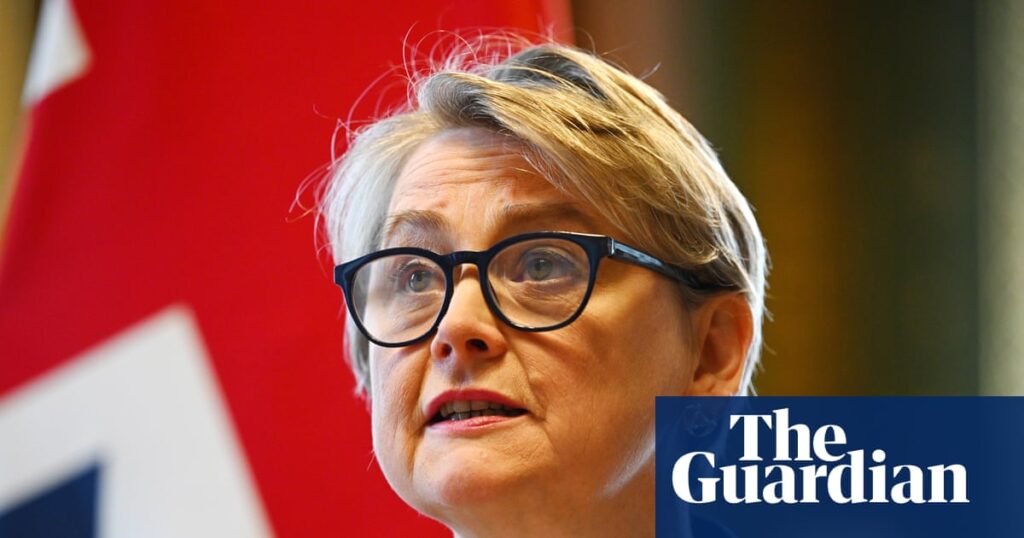

Artificial intelligence poses a “Hiroshima”-style risk to humanity if governments do not agree to curb how it is developed, the foreign secretary has warned.
Yvette Cooper urged countries, including the US and China, to agree international rules for AI, telling the Guardian she believes the issue will dominate foreign policy over the next two years.
In an essay covering her thoughts on everything from emerging technology to Palestine, Cooper said the world was at a dangerous moment, not least because of what she sees as the permanent withdrawal of the US from its role as a global arbiter.
And in a separate interview with the Guardian she spelled out her concerns over AI and the Palestine peace process in particular.
In her piece being published on Monday by the Chatham House thinktank, the foreign secretary said: “On nuclear, international agreement came only after the world saw the terrifying power of the new technology at Hiroshima – and asked what would happen if it fell into the wrong hands. We cannot afford to wait for an AI equivalent of Hiroshima before we act.”
She told the Guardian: “Across the world, people are feeling the same thing – there is amazing potential here, but there is also huge risk. We are already in a world where we have malign actors who will use technology against us – whether that be hybrid threats, whether that be state-backed criminal groups or other kinds of organisations, or extremists and terror groups.”
She added: “I think AI is going to end up being the dominant foreign policy issue that we deal with over the next two years.”
Cooper identified AI as just one area threatening global security at the moment as she also warned about the impact of the climate crisis, irregular migration and foreign interference on western liberal democracy.
Her essay gives one of the clearest and most comprehensive pictures of the foreign secretary’s worldview and where she thinks her department should devote its attention in the coming years.
It comes as senior Labour figures jostle for position in a likely Andy Burnham cabinet, with her former colleague David Miliband being tipped for a return to the Foreign Office in her place. Miliband will share his own thoughts on foreign policy in a lecture on Thursday entitled “Power and its missing guardrails”.
Cooper writes in her essay that European powers need to adjust to the idea that the US will no longer guarantee international peace and democracy, even after the end of Donald Trump’s presidency.
“We should no longer expect the US to play the role it once did,” she says. “There will continue to be issues where we disagree. But reduced dependence on any single ally will make us stronger.”
One answer, she says in her essay, is for the UK and EU to negotiate a more permanent settlement instead of trying constantly to renegotiate individual elements of their trading arrangements.
The government is putting the finishing touches on the latest round of EU…
Source link
Disclaimer
We strive to uphold the highest ethical standards in all of our reporting and coverage. We blogs.grocliq.com want to be transparent with our readers about any potential conflicts of interest that may arise in our work. It’s possible that some of the investors we feature may have connections to other businesses, including competitors or companies we write about. However, we want to assure our readers that this will not have any impact on the integrity or impartiality of our reporting. We are committed to delivering accurate, unbiased news and information to our audience, and we will continue to uphold our ethics and principles in all of our work. Thank you for your trust and support.
Website Upgradation is going on for any glitch kindly connect at [email protected]