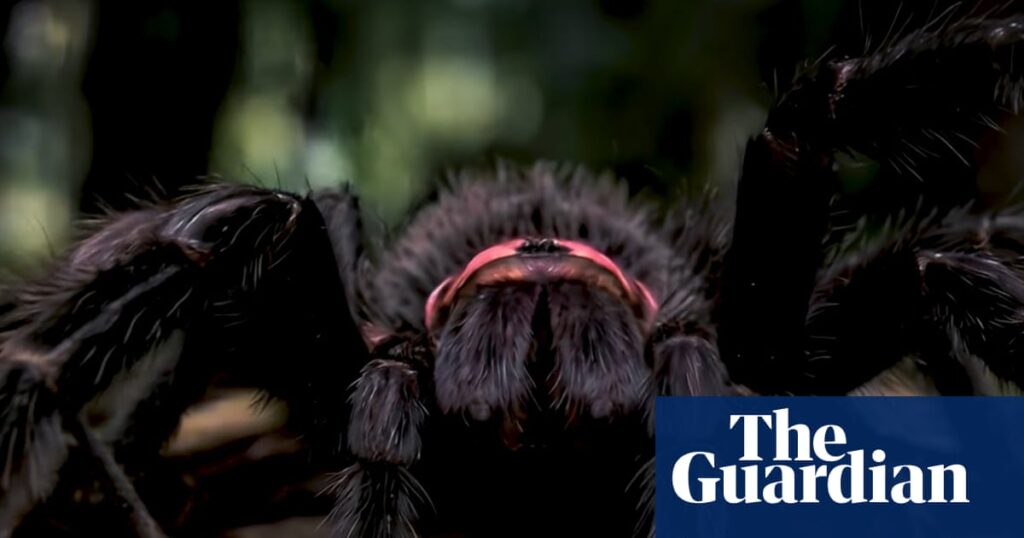

Scene: a dimly lit underground burrow. A giant Amazonian tarantula and a tiny dotted humming frog share the space, an unlikely duo captured in extraordinary detail.
Except, they haven’t been. Guardians of the Burrow, a short “wildlife documentary” by the Australian digital content designer Jodie Heenan, is entirely AI generated. At the weekend it won a prize in the Omni international AI film festival, adjudicated by a panel led by The Crow and Dark City director – and AI advocate – Alex Proyas.
The documentary doesn’t hide its origins: it says exactly how it was created on its YouTube page.
But AI is a controversial tool for creatives right now: the films use technology reportedly trained on stolen content. Last week musicians, authors and others roamed the halls of Australia’s parliament campaigning to protect their copyright, and communities across the country are mobilising against sprawling and power-hungry datacentres.
Heenan says she has weathered much criticism for her use of AI. She is part of an international team established by the California AI studio Fable (which has Amazon as one of its major investors) to reconstruct 44 minutes of Orson Welles’ The Magnificent Ambersons – giving it the ending Orson originally wanted, not the one Hollywood gave it in his absence.
The team’s use of AI to generate the digital likenesses and synthesised voices of the 1942 cast was criticised by the Orson Welles estate, which told Variety it was “a purely mechanical exercise without any of the uniquely innovative thinking or a creative force like Welles”.
But Heenan says AI has the capacity to show us the impossible – it’s a tool that can be used creatively, not just derivatively, as her documentary demonstrates.
She says even the likes of David Attenborough couldn’t have accurately conveyed how the fierce spider and tiny frog help and protect each other, because all the action takes place inside the spider’s lair. Lights and microscopic cameras would interfere with the natural behaviour.
“Nobody’s actually managed to capture [the spider and frog] on film in the wild, to my knowledge, so I thought that was a really great reason to use AI specifically,” she says.
“I can show the detail of the relationship, I can get into the spider’s burrow … and then recreate that in AI, but put it in a natural environment, so that it feels and looks like a real nature documentary.”
She researched how National Geographic, Animal Planet, and David Attenborough’s teams put their documentaries together, and steered clear of AI’s capacity for cheap special effects.
“No fancy camera tricks and morphs and warps, none of the fun stuff that AI can do that looks really cool,” she says. “I almost wanted it be: you’re in boring hotel room, you put on Nat Geo because there’s nothing else on the TV, and you get sucked in.”
AI film-makers from the US, the UK, Brazil, Ukraine, China and Australia were among the Omni category…
Source link
Disclaimer
We strive to uphold the highest ethical standards in all of our reporting and coverage. We blogs.grocliq.com want to be transparent with our readers about any potential conflicts of interest that may arise in our work. It’s possible that some of the investors we feature may have connections to other businesses, including competitors or companies we write about. However, we want to assure our readers that this will not have any impact on the integrity or impartiality of our reporting. We are committed to delivering accurate, unbiased news and information to our audience, and we will continue to uphold our ethics and principles in all of our work. Thank you for your trust and support.
Website Upgradation is going on for any glitch kindly connect at [email protected]