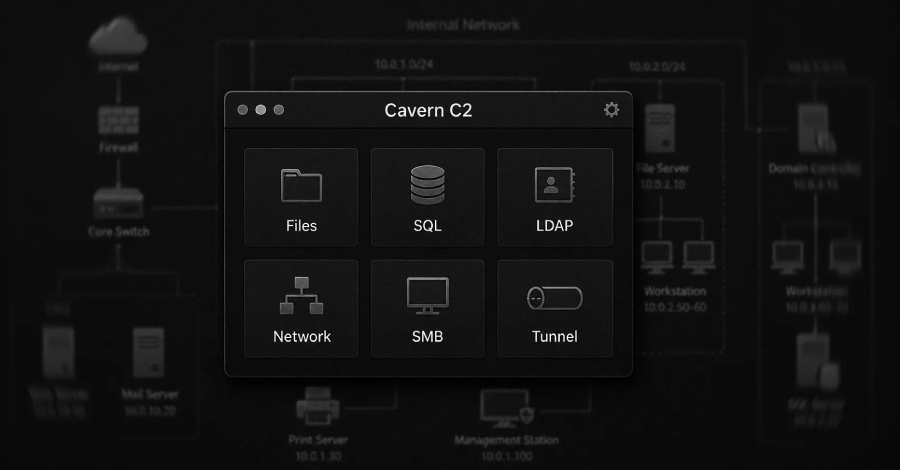


An Iranian hacking group affiliated with Iran’s Ministry of Intelligence and Security (MOIS) has been wielding a previously undocumented modular command-and-control (C2) framework dubbed Cavern (aka Cav3rn) targeting Israeli organizations.
The activity, which has primarily singled out IT providers and government sectors, has been attributed to a threat cluster tracked by Check Point Research under the moniker Cavern Manticore, which it said shares some level of tactical overlaps with MuddyWater and Lyceum, the latter of which is assessed to be a subgroup within OilRig.
“The framework reflects a mature and adaptable toolset built around a shared .NET foundation, while using multiple compilation formats across different components, including .NET Framework, .NET Mixed-Mode C++/CLI, and .NET Native AOT,” the cybersecurity company said.
“The compilation format itself becomes the anti-analysis layer that forces reverse engineers into multiple toolsets and metadata-reconstruction workflows.”
The components of the C2 framework are used as Cavern Agent and Cavern modules, demonstrating a clear division of responsibilities between core communication capabilities and mission-specific post-exploitation functionality. This architecture has inherent advantages as it allows the operators to tailor deployments based on the victim profile, reduce forensic visibility, and ensure persistent access through bespoke modules for reconnaissance, data theft, tunneling, and lateral movement.
The attack chain documented by Check Point Research commences with SysAid’s software update feature, which is leveraged by the adversary to initiate a DLL side-loading chain that leads to the execution of a trojanized DLL (“uxtheme.dll”) containing the Cavern Agent. The agent, for its part, loads a standalone communication DLL module (“n-HTCommp.dll”) to contact the C2 server (“hospitalinstallation[.]com”) and fetch additional post-exploitation modules on the fly over HTTPS or WebSocket.
As many as five DLL modules have been uncovered –
- mhm.dll, for file operations, enumeration, recursive file search, archive handling, and bidirectional file transfer
- db.dll, for SQL database enumeration, query, export, and manipulation
- ode.dll, for Active Directory reconnaissance, user/group enumeration, and LDAP brute-force attempts
- n-ten.dll, for network reconnaissance, port scanning, share enumeration, and SMB brute-force attempts
- n-sws.dll, for SOCKS5 proxy and WebSocket tunneling
A defining trait of the framework is its use of three different .NET compilation targets spanning its components: while mhm.dll, db.dll, and ode.dll are pure .NET Framework modules, n-HTCommp.dll, n-ten.dll, and n-sws.dll make use of Native AOT (Ahead-of-Time) compilation. The main agent, uxtheme.dll, combines managed .NET code with native C++ in a single portable executable.
Embedded within the agent is a unified module dispatcher that treats components whose names start with n- as native DLLs…
Source link
Disclaimer
We strive to uphold the highest ethical standards in all of our reporting and coverage. We blogs.grocliq.com want to be transparent with our readers about any potential conflicts of interest that may arise in our work. It’s possible that some of the investors we feature may have connections to other businesses, including competitors or companies we write about. However, we want to assure our readers that this will not have any impact on the integrity or impartiality of our reporting. We are committed to delivering accurate, unbiased news and information to our audience, and we will continue to uphold our ethics and principles in all of our work. Thank you for your trust and support.
Website Upgradation is going on for any glitch kindly connect at [email protected]