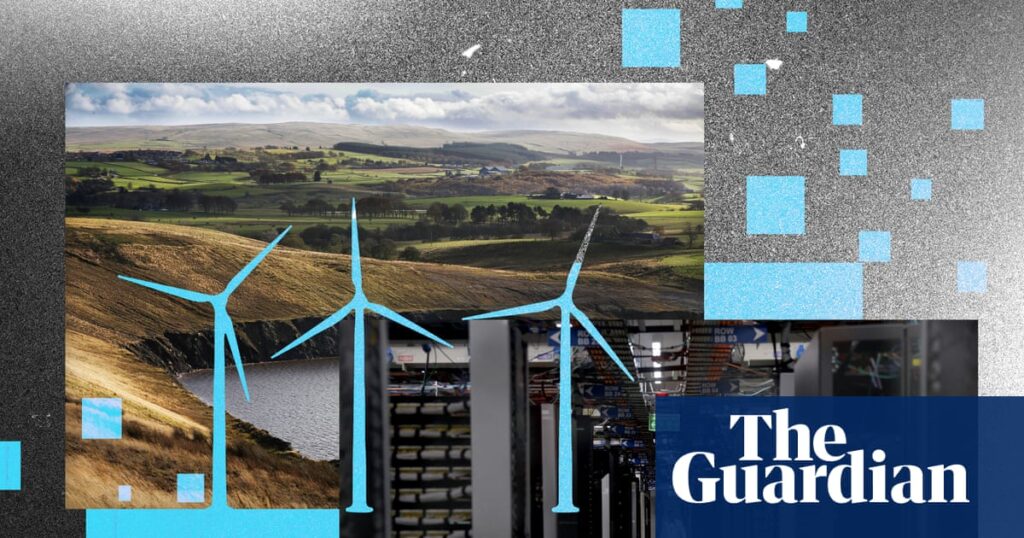

A landmark AI development billed as delivering jobs and prosperity has misrepresented its plans to channel a nuclear reactor’s worth of power to a site in rural Scotland, a Guardian investigation has found.
When it was announced in January, the government promised that an £8.2bn AI datacentre complex in Lanarkshire – built by the US firm CoreWeave and the Scottish company DataVita – would be powered entirely from on-site renewables and built by 2030.
The AI datacentre complex represented a large part of Britain’s ambitions to keep up in the global AI race by building the infrastructure that underpins artificial intelligence. A central plank of the project’s viability was its ability to power itself.
But documents obtained through freedom of information (FoI) requests and analysis of public records suggest the datacentre has no prospect of meeting that goal.
The Guardian obtained internal correspondence showing that the government and the site’s developers, even as they publicly promised that the Lanarkshire site would have up to 1GW of “new energy infrastructure”, were privately acknowledging that the site had an “issue” with “power provision” and that this would not happen.
In response to questions from the Guardian, the government said the Lanarkshire complex would connect to the grid. This means it will either join a years-long queue or be expedited ahead of hundreds of other projects also vying for a connection. A government spokesperson said the site’s needs would still be met “overwhelmingly” with renewables.
The findings raise critical doubts over the UK’s ability to confront the key question now facing the world’s massive AI buildout: how to provide the extraordinary energy required to make it plausible.
‘At best indicative, at worst complete bunk’
AI datacentres are, essentially, buildings full of very specialised silicon chips. The chips do the calculations that underpin artificial intelligence models. The world’s biggest tech companies are now ploughing hundreds of billions of dollars into the buildout of AI datacentres. Behind all this spending is the belief that AI will fundamentally transform the global economy, and that once it does, the AI datacentres will pay for themselves.
The question of whether AI is a boom or bubble now largely rests on huge infrastructure projects such as Lanarkshire.
The new details are not the first signal of problems in the UK’s burgeoning datacentre industry. In March, the Guardian reported that a series of high-profile projects announced over the past years were “phantom investments”, with the government failing to examine claims of job creation or audit multibillion-pound sums.
Power is a particularly fraught issue in the UK, where it is more expensive than anywhere else in Europe. There is an eight- to 10-year queue for new developments to connect to the grid, a delay that hangs over houses and hospitals as well as datacentres.
Britain is not the only place…
Source link
Disclaimer
We strive to uphold the highest ethical standards in all of our reporting and coverage. We blogs.grocliq.com want to be transparent with our readers about any potential conflicts of interest that may arise in our work. It’s possible that some of the investors we feature may have connections to other businesses, including competitors or companies we write about. However, we want to assure our readers that this will not have any impact on the integrity or impartiality of our reporting. We are committed to delivering accurate, unbiased news and information to our audience, and we will continue to uphold our ethics and principles in all of our work. Thank you for your trust and support.
Website Upgradation is going on for any glitch kindly connect at [email protected]