

A threat actor has been targeting organizations spanning multiple sectors with voice-based fake security requests that prompt Microsoft 365 users to enroll a new Entra passkey with an aim to carry out data extortion attacks.
The threat actor, tracked by Okta under the moniker O-UNC-066, has deployed a panel-controlled phishing kit that’s capable of targeting the passkey enrollment process. The activity has singled out food and beverage, technology, healthcare, automotive, construction, and aviation industries.
“The threat actor registers domains that incorporate the word passkey as part of a voice-enabled phishing (‘vishing’) scheme,” Okta researcher Houssem Eddine Bordjiba said. “The threat actor then calls targeted users on the phone in an attempt to persuade them that they need to register a new passkey.”
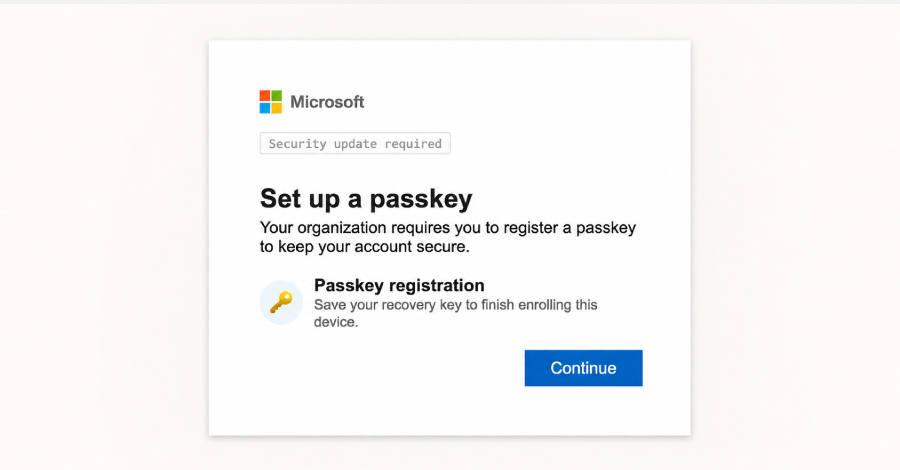
Users are then directed to a phishing kit that’s identical to the Microsoft passkey enrollment process, giving the impression that they are adding a passkey with Microsoft, when, in reality, the threat actor registers their own passkey against their Microsoft account, granting them unauthorized access.
The development coincides with Microsoft allowing administrators to configure registration campaigns to nudge users to register passkeys during sign-in in an attempt to help organizations drive passkey adoption at scale. In other words, threat actors are abusing the phishing-resistant security upgrade process as a lure to enroll their own passkeys within victims’ accounts and facilitate follow-on activities.
Unlike adversary-in-the-middle (AitM) landing pages that are prevalent in phishing campaigns designed to steal credentials and multi-factor authentication (MFA) tokens, the phishing kit used in these attacks is an operator-controlled PHP panel in which a victim is guided through the passkey enrollment process in almost real-time.
“The operator can use the kit to adapt the user experience to each victim’s MFA requirements (TOTP, push notification with number matching, SMS OTP) during the session,” the identity security company said. “The caller can control and adjust in real time what phishing pages and notifications a targeted user sees.”
It’s suspected that the threat actor is leveraging the kit to take over the victim account and trick the user into approving an attacker-initiated registration of a passkey. There is no indication at this stage to suggest that the kit is redirecting users to third-party identity providers like Okta.
The entire sequence of actions is below –
- The first page of the phishing kit (/gate) displays a page loading icon while the phishing kit performs anti-analysis checks in the background.
- The second page (/identify) requests a username.
- The next page (/password) challenges the user for a password.
- The harvested credentials are sent in a POST request to an operator panel at “/backend.php.”
- The phishing kit operator…
Source link
Disclaimer
We strive to uphold the highest ethical standards in all of our reporting and coverage. We blogs.grocliq.com want to be transparent with our readers about any potential conflicts of interest that may arise in our work. It’s possible that some of the investors we feature may have connections to other businesses, including competitors or companies we write about. However, we want to assure our readers that this will not have any impact on the integrity or impartiality of our reporting. We are committed to delivering accurate, unbiased news and information to our audience, and we will continue to uphold our ethics and principles in all of our work. Thank you for your trust and support.
Website Upgradation is going on for any glitch kindly connect at [email protected]