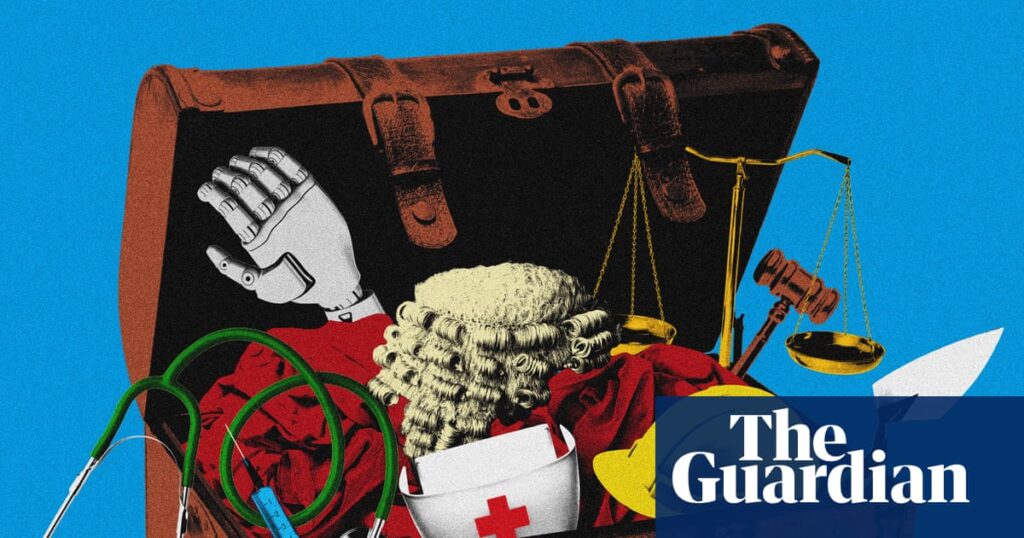

Entering the world of work often brings some uncertainty, but now there is another question: how can I AI-proof my career?
We asked people from across various industries what they think the impact of AI will be on careers, and which jobs may be less affected. While it is still early days for the tech, many had ideas about how you can best prepare yourself for a successful career in this new world.
Medicine
‘Pharmacists, doctors, nurses and other prescribing clinicians will have a role’
Some of the healthcare jobs most vulnerable to disruption by AI include medical secretaries, pharmacy support staff, prescription processing and call handling teams, says Hira Malik, a superintendent pharmacist and co-founder of Oushk Pharmacy.
She says the impact will fall on admin-led healthcare roles where staff are working with set forms, records or patient queries, rather than making clinical decisions. In online pharmacy, that could include checking consultation forms, chasing missing details, processing prescription requests, triaging standard patient queries or routing cases to a pharmacist. While these positions are unlikely to disappear completely, many of the tasks they involve could become automated.
Malik says pharmacists, doctors, nurses and other prescribing clinicians remain far less susceptible to replacement because they carry responsibility for patient safety and treatment decisions. “AI can help organise information and flag risks, but it cannot decide whether treatment is safe or appropriate,” she says.
Some specialities, such as plastic surgery, are unlikely to be replaced owing to their highly individual nature, but areas such as radiology are more at risk. Consultant plastic and reconstructive surgeon Dr Riaz Agha says: “Plastic surgery is too bespoke and too individualised. Every patient is different.” But AI may eventually help a surgeon analyse past cases to support their decision-making, he adds.
According to Agha, radiology is a speciality “which is particularly vulnerable”. He says: “There have now been many studies showing that AI can interpret scans with extremely high levels of accuracy and reliability. That does not necessarily mean radiologists disappear, but their role may evolve significantly.”
His advice is that future doctors should learn how to use AI “properly and understand both its strengths and limitations”.
Education and early years
‘Childminding is one of the careers least likely to be replaced by AI’
In education, AI is again most likely to affect administrative and routine teaching support roles rather than fully replacing teachers, experts say.
“In terms of career choices, teaching is an excellent one,” says Sharath Jeevan, founder of Oxford University’s Generational Success Lab. “Students will always need trusted adult relationships to help them learn.”
Another area expected to…
Source link
Disclaimer
We strive to uphold the highest ethical standards in all of our reporting and coverage. We blogs.grocliq.com want to be transparent with our readers about any potential conflicts of interest that may arise in our work. It’s possible that some of the investors we feature may have connections to other businesses, including competitors or companies we write about. However, we want to assure our readers that this will not have any impact on the integrity or impartiality of our reporting. We are committed to delivering accurate, unbiased news and information to our audience, and we will continue to uphold our ethics and principles in all of our work. Thank you for your trust and support.
Website Upgradation is going on for any glitch kindly connect at [email protected]