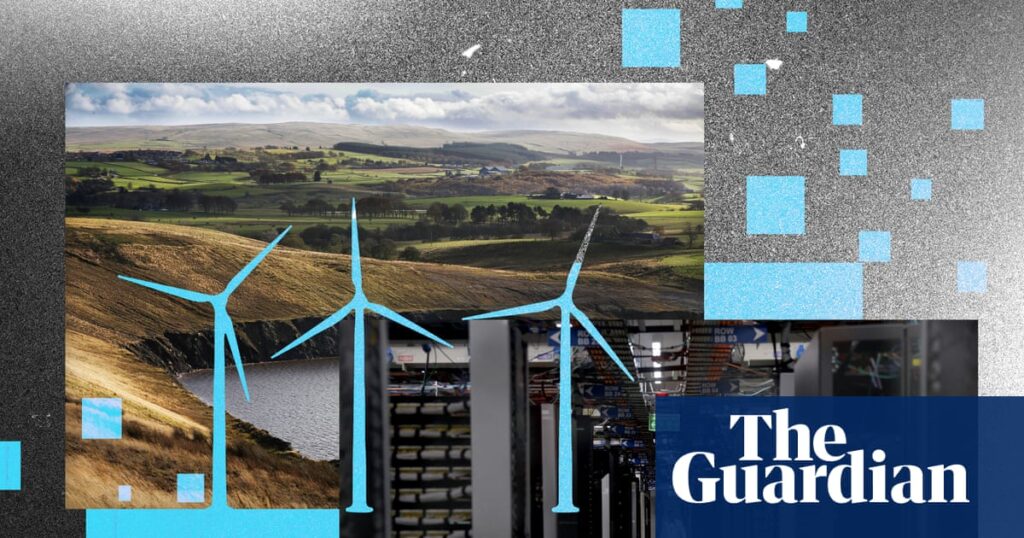

Journalists often use the term “shoe-leather reporting” to refer to the on-the-ground legwork that goes into covering certain stories. As the tech industry’s focus has shifted from screen-based realities to the physical world of colossal AI datacentres and social media harms, comfortable footwear has become more essential to a tech reporter’s job.
Earlier this week, we published the Guardian’s latest investigation into the datacentres and energy infrastructures that underpin AI – revealing that an £8.2bn AI complex in rural Scotland has misrepresented its plans to be powered entirely by on-site renewables. “Our reporting is showing that you can’t simply wave a magic wand and have a datacentre appear,” says Aisha Down, who covers AI for the Guardian and went to Scotland to investigate the story. “There are a lot of huge physical constraints and reality checks. These physical, tangible things are what makes or sinks the AI boom.”
Much of this reporting involves interrogating the reality of all this tangible stuff – whether or not the infrastructure proposals by tech giants are realistic, whether the datacentres themselves are feasible, whether the energy and water commitments are genuine, whether the promised job creation is real and, above all, what it means for real-life, actual people.
The datacentre investigation published this week illustrates the growing intersection of tech reporting with energy and environment stories. It involved Aisha trekking around Lanarkshire to sites where datacentres and energy infrastructure might be built, talking with local residents, examining public records and obtaining internal documents. It followed a similar investigation earlier this year in which she checked out a four-acre site on the outskirts of London that is due to house a gleaming AI supercomputer complex – only to find that it was still being used as a scaffolding yard.
And, yes, both stories involved a lot of “shoe-leather reporting” – although, technically, Aisha wasn’t wearing leather-soled shoes: “I wear very light flats with rubber soles and a band that makes them good for walking in. In Lanarkshire, I wore sneakers.”
Dan Milmo, our global technology editor (who generally wears rubber-soled chukka boots), published an article about the number of large datacentre projects around the world that are being challenged or cancelled. “I remember going out to a site in Wales that was about as well-organised and well-funded as you can get, and I still got a sense of how difficult it is for tech companies to pull off these big infrastructure projects,” he says.
The physical reality checks on AI include the capacity of local electricity grids, the availability of chips and other components, as well as the impact on tech companies’ carbon footprints and sustainability goals. “The AI boom has radically changed the physical presence of all of these tech companies in the physical world,” says Blake Montgomery,…
Source link
Disclaimer
We strive to uphold the highest ethical standards in all of our reporting and coverage. We blogs.grocliq.com want to be transparent with our readers about any potential conflicts of interest that may arise in our work. It’s possible that some of the investors we feature may have connections to other businesses, including competitors or companies we write about. However, we want to assure our readers that this will not have any impact on the integrity or impartiality of our reporting. We are committed to delivering accurate, unbiased news and information to our audience, and we will continue to uphold our ethics and principles in all of our work. Thank you for your trust and support.
Website Upgradation is going on for any glitch kindly connect at [email protected]