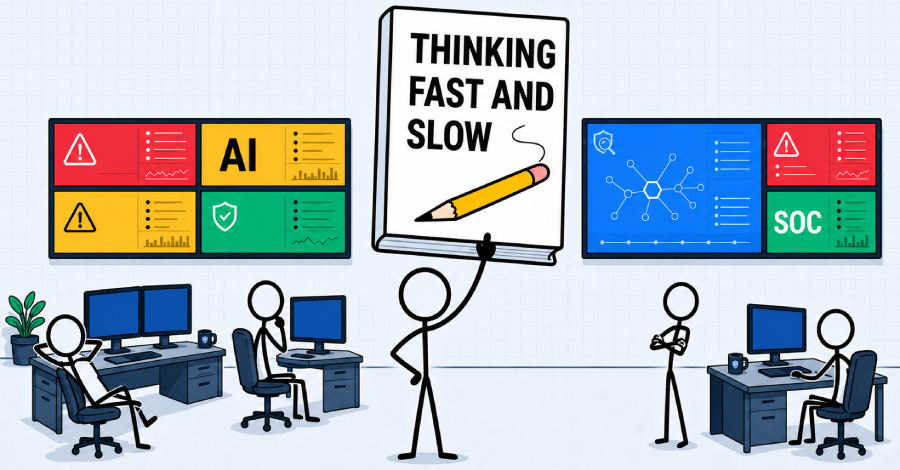


A few days ago, I was sitting with the CISO of a Fortune 50 company, walking through how his security team was thinking about AI agents in the SOC. Smart team. Serious program. They had already connected Claude to a few detection tools and were seeing real value in specific investigations. But as we mapped out the broader architecture, something kept nagging at me. The design they were building was going to work beautifully for a tiny percentage of alerts that genuinely needed deep human judgment. It was going to completely ignore the rest.
On the flight home, I picked up a book I had not touched in a few years. Daniel Kahneman’s Thinking, Fast and Slow. Kahneman is one of the rare people who genuinely changed how we understand human decision-making. He spent his career as a psychologist studying how people actually think, as opposed to how economists assumed they did. In 2002, he won the Nobel Prize in Economics, which tells you something about how far his work traveled beyond its starting point.
The book’s central argument is that the human mind is not one thing. It is two systems operating in parallel, often in tension.
System 1 is the brain that runs automatically. It recognizes patterns instantly, reads a room in seconds, and keeps you alive without conscious effort. It is fast, associative, and unconscious. According to Kahneman’s research, 95% of all human cognition happens here, running quietly in the background like an operating system you never see.
System 2 is the brain you engage with for hard things. Evaluating a contract, working through a problem with no obvious answer, and making a judgment call under pressure. It is slow, logical, effortful, and it accounts for the remaining 5% of our thinking. It can override System 1 when System 1 is wrong. But it has limited capacity. You cannot run it at full power all day. When it gets exhausted, System 1 takes over regardless.
Kahneman’s core insight is not that one system is better. It is that the errors humans make are almost always the result of applying the wrong system to the wrong job. Deliberate thinking applied to things that should be automatic burns people out and still misses things. Automatic thinking applied to things that genuinely need deliberation produces confident mistakes.
I landed, opened my laptop, and wrote one sentence to myself. “This is exactly what is wrong with how most security teams are designing their AI architecture right now.”
The numbers are not a coincidence
Kahneman says humans run System 1 for 95% of their cognition and System 2 for 5%. Research based on analysis of more than 25 million enterprise alerts found that 98% of alerts can be resolved autonomously with less than 2% actually warranting human review.

This is almost identical to Kahneman’s ratio. The SOC that performs well is not some new invention. It is the architecture that mirrors how the best decision-making minds actually operate. Fast, automatic processing for the…
Source link
Disclaimer
We strive to uphold the highest ethical standards in all of our reporting and coverage. We blogs.grocliq.com want to be transparent with our readers about any potential conflicts of interest that may arise in our work. It’s possible that some of the investors we feature may have connections to other businesses, including competitors or companies we write about. However, we want to assure our readers that this will not have any impact on the integrity or impartiality of our reporting. We are committed to delivering accurate, unbiased news and information to our audience, and we will continue to uphold our ethics and principles in all of our work. Thank you for your trust and support.
Website Upgradation is going on for any glitch kindly connect at [email protected]