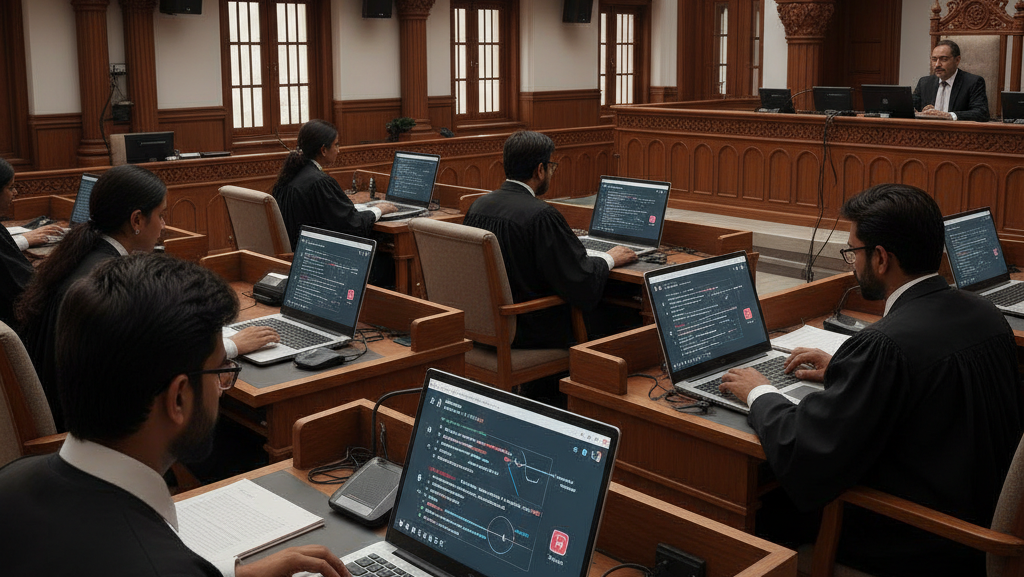

The Kerala High Court has mandated that all witness depositions starting November 1 will be “primarily recorded” using the Adalat AI, a Voice-to-Text Transcription Tool. This makes Kerala the first Indian state to mandate AI transcription as a default across its district courts.
Through Phase III of the e-Courts Project, the Ministry of Law and Justice has made it a national priority to fund AI and NLP tools to create paperless courts. This is aimed to be achieved in a decentralised manner through the respective High Courts. In that regard, the Kerala High Court had earlier released its ‘Policy Regarding Use of Artificial Intelligence Tools in District Judiciary‘. This document demonstrates a strong awareness of AI’s risks and clearly defines the strict “guardrails” governing the deployment of the Adalat AI tool.
However, is this mandate by the Kerala HC too significant a leap forward without having considered how to contain risks such as accuracy, reliability and language-related technicalities?
Context of the Adalat AI Directive
The Kerala High Court’s action is the decentralised implementation of Phase III of the eCourts Project. This four-year national scheme, launched in 2023, aims to build a unified technology platform that offers a seamless, paperless interface for all judicial stakeholders. It explicitly calls for the “use of latest technologies like AI and its subsets… Natural Language Processing (NLP)” to build a “smart” ecosystem and reduce data entry and the number of pending cases.
Before issuing this mandate, the Kerala High Court first detailed its policy on “responsible and restricted use of Artificial Intelligence in judicial functions of the District Judiciary”. It clearly acknowledges that “most AI Tools produce erroneous, incomplete, or biased results.” Therefore, it legally requires that all AI outputs “must be meticulously verified by the judicial officers”. The policy warns against using unvetted, public AI like ChatGPT, as it can cause “serious violations of confidentiality”. To address this concern, the policy introduces an “Approved AI Tools” category, which is likely to include the use of Adalat AI.
Adalat AI for Witness Deposition
The eCourts Phase III plan effectively empowers each High Court to act as a decentralised “lab” for judicial modernisation. Using this decentralised authority, the Kerala High Court became India’s first to mandate a paperless, AI-based system for recording evidence. Starting November 1, 2025, the Adalat AI tool will record all witness depositions in subordinate courts.
Earlier, court stenographers recorded witness depositions manually, which made the process time-consuming. Adalat AI aims to act as the “plumber of the court system” by using AI to automate manual tasks. By automating transcription, the tool enables judges and court staff to “focus on what actually matters”.
The witness will digitally
Source link
Disclaimer
We strive to uphold the highest ethical standards in all of our reporting and coverage. We blogs.grocliq.com want to be transparent with our readers about any potential conflicts of interest that may arise in our work. It’s possible that some of the investors we feature may have connections to other businesses, including competitors or companies we write about. However, we want to assure our readers that this will not have any impact on the integrity or impartiality of our reporting. We are committed to delivering accurate, unbiased news and information to our audience, and we will continue to uphold our ethics and principles in all of our work. Thank you for your trust and support.
Website Upgradation is going on for any glitch kindly connect at [email protected]